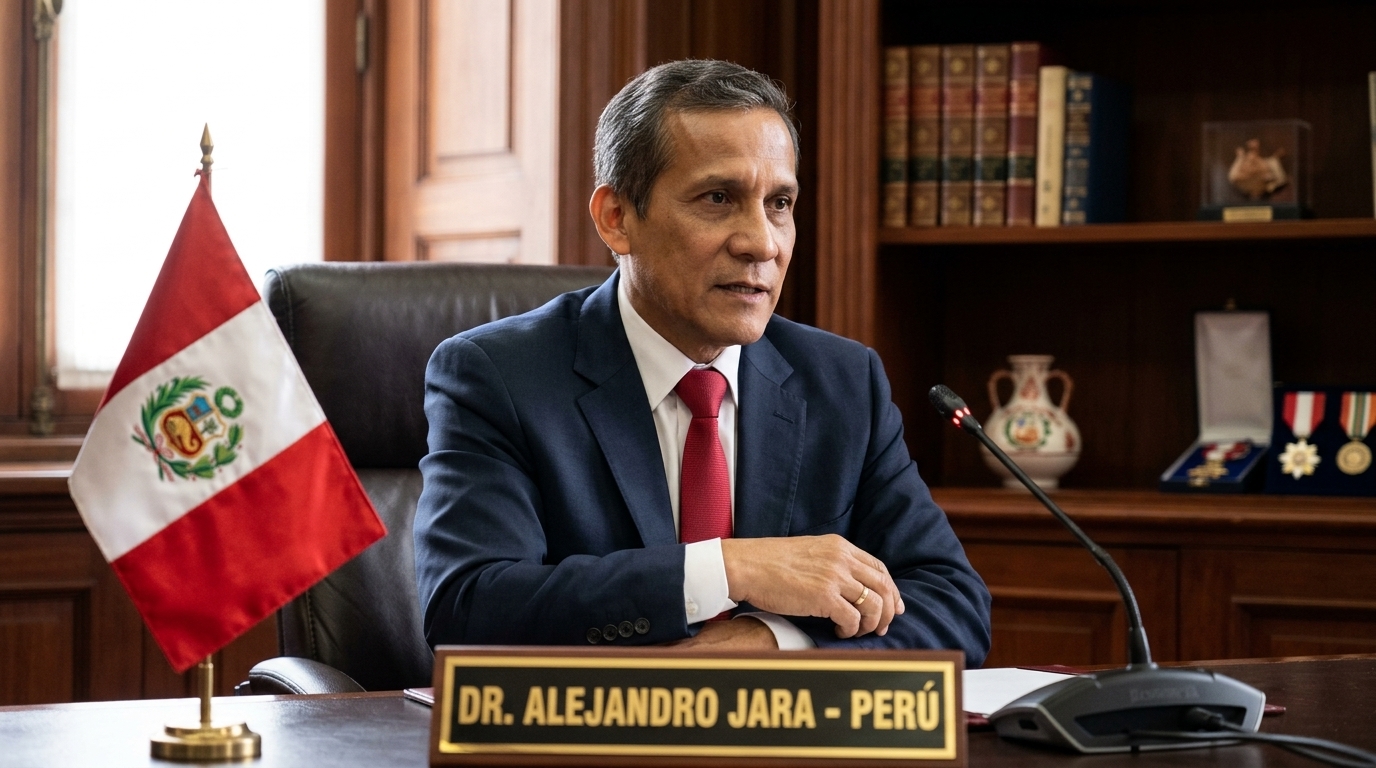
Ollanta Humala Tasso, who served as president of Peru from 2011 to 2016, is facing legal proceedings on several different counts. The best-known case involved campaign contributions from the 2006 and 2011 elections, which resulted in a 15-year prison sentence in April 2025. However, the Constitutional Court overturned the entire case in July 2026.
The short answer
There is currently no final, enforceable conviction against Ollanta Humala for money laundering stemming from his 2006 and 2011 campaign contributions. The Constitutional Court overturned the entire case in July 2026, ruling that the principles of legality and criminal definability had been violated. This does not amount to an acquittal on the merits of the case. Furthermore, Humala faces other ongoing legal proceedings, including the “Madre Mía” case and the case involving the Southern Peruvian Gas Pipeline.
What Happened to the 15-Year Sentence for Money Laundering
On April 15, 2025, the Third National Criminal Court sentenced Ollanta Humala and Nadine Heredia to 15 years of actual imprisonment for aggravated money laundering. The court held that the contributions received by the Peruvian Nationalist Party for the 2006 and 2011 campaigns were of illicit origin and had been presented as regular party contributions.
The ruling came after a trial that began in 2022. According to the Judiciary, 220 witnesses testified during the proceedings. In addition, 57 people denied having made contributions that the party had attributed to them during the 2006 campaign.
The ruling also established that, in the 2011 campaign, contributions totaling S/4,329,370 attributed to individuals who denied having made them were not recognized. The ruling further imposed penalties on other individuals involved and ordered joint civil damages of S/10 million.
Humala’s defense team announced that it would appeal the decision. Therefore, the status of the proceedings should be distinguished from a final judgment.
However, subsequent developments substantially altered the legal situation.
The Constitutional Court annulled the entire proceeding
The Constitutional Court ruled that the habeas corpus petition filed on behalf of Humala was well-founded and annulled the entire criminal proceeding for money laundering. The decision was issued by a majority vote and is recorded in Case No. 00110-2026-PHC/TC.
The Constitutional Court found that the principles of criminal legality and specific criminal definition had been violated. One of the central points was that the form of property receipt used to support the charge was introduced by Legislative Decree 1249 in November 2016.
The facts under investigation pertained to the 2006 and 2011 election campaigns. Therefore, the Court held that this criminal provision could not be applied retroactively to support the charges.
The Court also took issue with the fact that the ordinary courts had failed to specifically identify the underlying crime from which the alleged illicit funds originated. Furthermore, it noted that knowledge of the illicit origin of the funds must be objectively proven.
The ruling received five votes in favor and two dissenting votes. Justices Luz Pacheco Zerga and Manuel Monteagudo Valdez issued dissenting opinions.
Overturning the Conviction Does Not Mean Acquittal
The legal distinction is important.
An acquittal implies that a court analyzes the merits of the case and concludes that the person should not be convicted of the alleged offenses. An annulment, on the other hand, dismisses the proceedings or a judicial action for legal or procedural reasons.
In this case, the Constitutional Court did not declare that the contributions never existed. Its decision focused on the application of criminal law and on the constitutional guarantees related to legality and criminal definability. The case file itself expressly states that the ruling did not determine whether the contributions existed, but rather addressed their criminal treatment under the legislation in force at the time of the events.
Therefore, the 15-year sentence should not currently be presented as a valid conviction.
From Barbadillo Prison to Freedom
Humala was arrested in April 2025 immediately after the sentence was read and transferred to the Barbadillo prison in Ate.
This was not his first period of incarceration related to the campaign contributions case. Between 2017 and 2018, Humala and Nadine Heredia were held in pretrial detention while the investigation was ongoing.
During that period, the Judiciary and the Constitutional Court analyzed the necessity and proportionality of the restrictive measures. The case file shows that Humala remained in custody for more than a year.
Following the Constitutional Court’s July 2026 decision, the Judiciary acknowledged compliance with the Constitutional Court’s ruling and the need to determine the former president’s legal status. Humala was released from Barbadillo on July 31, 2026.
His release from prison was directly related to the annulment of the proceedings that had led to his conviction.
The “Madre Mía” Case: A Separate and Still-Open Case
The Madre Mía case is not a corruption case. It is an investigation related to events that occurred while Humala was an Army officer.
In November 2025, the Public Prosecutor’s Office formally initiated a preliminary investigation against Humala and four other former military officers for the alleged crimes of aggravated homicide and forced disappearance. The events under investigation date back to 1992 and are related to the Madre Mía military base in Huánuco.
The Prosecutor’s Office identified Edgardo Isla Pérez and Némer Acuña Silva as victims under investigation, in addition to other individuals whose disappearances are being investigated. The investigation also covers events related to alleged extrajudicial killings and disappearances.
Humala has publicly acknowledged using the alias “Captain Carlos” during his time at the base.
The case had previously been closed. However, it was later reopened based on new evidence and testimony. The main document of this investigation notes that in 2026, the Judiciary extended the investigation period until January 2027.
For now, the key issue is procedural: there is no ruling establishing Humala’s criminal liability for the events under investigation at Madre Mía.
Southern Peruvian Gas Pipeline: The Ongoing Corruption Scandal
Another relevant case involves the Southern Peruvian Gas Pipeline, a project awarded during the Humala administration to a consortium comprising Odebrecht and Enagás.
The Public Prosecutor’s Office alleges that Humala and Nadine Heredia were involved in acts related to the awarding of the project. In June 2025, the Public Prosecutor’s Office sought a 35-year prison sentence for the former presidential couple for the crimes then included in the indictment.
This case should be distinguished from the proceedings regarding campaign contributions. They are separate investigations and have different procedural grounds.
In July 2026, the Judiciary dismissed the charge of criminal association linked to the case. The decision was based on the application of Law 32108 and the interpretation of the elements of the crime.
However, that dismissal did not close the entire case.
In August 2026, the Judiciary rejected Humala and Heredia’s request to dismiss the charge of aggravated collusion. The defense argued that the prosecution’s indictment did not meet the elements required for the criminal offense. The court rejected that argument and ordered the case to proceed.
In addition, the Prosecutor’s Office appealed the decision regarding the dismissal of the criminal conspiracy charges. Therefore, the case still has pending legal proceedings.
What Is Still Pending and What Is Not
| Charges | Fact or Charge | Status as of October 7, 2026 | Level of Evidence |
|---|---|---|---|
| Contributions in 2006 and 2011 | Money laundering | Criminal proceedings overturned by the Constitutional Court | Overturning Confirmed |
| 15-year sentence | Judgment of April 2025 | No longer in effect following the annulment of the proceedings | Overturned |
| Imprisonment in Barbadillo | Imprisonment following the sentencing | Humala was released on July 31, 2026 | Fact confirmed |
| Pretrial detention 2017–2018 | Measure during investigation | Period concluded | Confirmed fact |
| Oh my God | Aggravated homicide and forced disappearance | Preliminary investigation opened | Under investigation |
| Southern Gas Pipeline | Aggravated Collusion | Proceedings ongoing | In progress |
| Southern Gas Pipeline | Criminal conspiracy | Charges dismissed; decision appealed by the Prosecutor’s Office | Under procedural dispute |
| Levantamiento de Locumba | 2000 Military Rebellion | Granted amnesty by Congress | Confirmed historical event |
The 2000 Locumba Uprising
Before his political career, Humala led a military uprising in Locumba, Tacna.
On October 29, 2000, while serving as a lieutenant colonel in the Army, he left the barracks along with about 60 soldiers. He was accompanied by his brother, Antauro Humala. The stated objective was to demand the resignation of Alberto Fujimori.
The incident included the seizure of a mining camp and the detention of General Carlos Bardales. The rebellion ended with the surrender of the Humala brothers.
Congress subsequently passed Law 27381, which granted amnesty to military personnel and civilians who participated in the uprising. Therefore, this episode belongs to the historical and political context of Humala’s career and should not be presented as a current criminal conviction.
What Sets These Cases Apart
The various aspects of Humala’s case do not share the same origin or legal status.
The case involving campaign contributions was related to the 2006 and 2011 presidential campaigns. That proceeding first resulted in a conviction and was later declared entirely null and void by the Constitutional Court.
The “Madre Mía” case pertains to events that occurred during his military service in 1992. The investigation relates to alleged crimes against life and liberty.
The Southern Peruvian Gas Pipeline case involves decisions related to a major public works project awarded during his administration. The charges of aggravated collusion are still pending.
This distinction is essential to avoid an incorrect conclusion: that the annulment of the money laundering conviction automatically closed all other cases.
So, what has been proven?
- Proved: Ollanta Humala was president of Peru from 2011 to 2016.
- Proved: In April 2025, a criminal court sentenced him to 15 years in prison for money laundering related to campaign contributions.
- Proved: The Constitutional Court subsequently annulled the entire criminal proceeding related to that conviction.
- Proven: Humala was incarcerated at Barbadillo following the April 2025 sentencing and was released from prison after the July 2026 constitutional ruling.
- Documented, disputed: The Prosecutor’s Office maintains a charge of aggravated collusion related to the Southern Peruvian Gas Pipeline. In August 2026, the Judiciary rejected Humala and Heredia’s request to dismiss that charge.
- Under investigation: The Madre Mía case continues as a preliminary investigation into alleged homicides and disappearances that occurred in 1992.
- No current conviction: The annulment of the proceedings regarding campaign contributions does not amount to an acquittal regarding the existence or nonexistence of those contributions.
How to Read Ollanta Humala’s Case File
Ollanta Humala’s case file requires distinguishing between three issues: what happened, what a judicial authority determined, and what is still under investigation.
The 2025 conviction falls into the first category of judicial decisions, but it ceased to have effect following the 2026 constitutional ruling. The Constitutional Court did not confirm Humala’s innocence regarding the merits of the campaign contributions. It annulled the proceedings for reasons related to criminal law and the legal definition of the offense.
The “Madre Mía” and “Gasoducto Sur” cases also cannot be summarized as convictions. In the former, there is a preliminary investigation into alleged serious crimes. In the latter, the case regarding aggravated collusion remains active.
Therefore, the most accurate description of the case as of October 2026 is that of a set of proceedings at different stages: a conviction that was overturned, an investigation into events from the military era, and a case related to a public contract award that is still pending in court.
Frequently Asked Questions (FAQ)
Is Ollanta Humala still serving a 15-year prison sentence?
No. In July 2026, the Constitutional Court overturned the entire criminal proceeding that had resulted in a 15-year sentence for money laundering. The decision was based on violations of the principles of criminal legality and the requirement that an act be specifically defined as a crime. Humala was released from Barbadillo Prison on July 31, 2026.
Did the Constitutional Court acquit Ollanta Humala?
No. The Constitutional Court overturned the criminal proceedings on constitutional grounds related to the application of criminal law. Its decision did not establish that the campaign contributions never existed. Therefore, legally speaking, the ruling should not be described as an acquittal on the merits of the charges.
What happened with the Madre Mía case?
It remains open. The Public Prosecutor’s Office initiated a preliminary investigation against Humala and other former military officers for alleged crimes of aggravated homicide and forced disappearance related to events that occurred in 1992. The investigation does not amount to a conviction, and according to the reviewed case file, there is no judgment against Humala in this case.
Is Ollanta Humala still under investigation for the Southern Peruvian Gas Pipeline?
Yes. The case involving aggravated collusion is ongoing. In August 2026, the Judiciary rejected Humala and Nadine Heredia’s request to dismiss that charge. Therefore, the annulment of the case regarding campaign contributions did not automatically close the Southern Gas Pipeline case.
Was the entire Southern Gas Pipeline case dismissed?
No. The Judiciary dismissed the charge of criminal conspiracy, but the charge of aggravated collusion remained. In addition, the Prosecutor’s Office appealed the decision regarding criminal conspiracy. Consequently, the case still has pending proceedings and cannot be described as completely closed.
Was Ollanta Humala in prison before his 2025 sentencing?
Yes. Humala was held in pretrial detention between 2017 and 2018 while the investigation into his campaign financing was underway. That period of pretrial detention was separate from his incarceration following his April 2025 conviction.
What was the Locumba uprising?
It was a military rebellion led by Ollanta Humala in October 2000 against the government of Alberto Fujimori. Humala left the Locumba barracks along with about 60 soldiers and was later granted amnesty by Congress through Law 27381.
Sources consulted
- Constitutional Court — The Constitutional Court (TC) ruled in favor of former President Ollanta Humala’s habeas corpus petition and ordered the criminal proceedings for money laundering to be nullified (July 31, 2026).
- Peruvian Judiciary — Ruling on the legal status of Ollanta Humala following the Constitutional Court’s decision (July 31, 2026).
- Public Prosecutor’s Office — Human Rights Prosecutor’s Office formally opens an investigation into the “Madre Mía” case against Ollanta Humala (November 11, 2025).
- Peruvian Judiciary — Information on the Southern Peruvian Gas Pipeline case.
- RPP — The Peruvian Judiciary rejects a request by Ollanta Humala and his wife to dismiss the Southern Gas Pipeline case (August 21, 2026).
- RPP — Prosecutor’s Office requests revocation of the ruling that dismissed the charge of criminal conspiracy against Ollanta Humala and Nadine Heredia (July 30, 2026).
- La República — The Judiciary sentences Humala and Heredia to 15 years in prison (April 15, 2025).
- Infobae — Constitutional Court overturns the entire criminal case against Ollanta Humala and paves the way for his release (July 31, 2026).
- El Peruano — Ollanta Humala left Barbadillo Prison in compliance with the Constitutional Court’s ruling (July 31, 2026).
- El Comercio — Ollanta Humala: Key Facts About the Locumba Uprising.
This article compiles documented facts and allegations attributed to their authors. The mention of an allegation does not imply its veracity, and the responses of the person mentioned are included in each case. Auditoría Abierta offers the person mentioned an opportunity to respond and will update the article with any new developments. Information verified as of October 7, 2026.

Investigative Journalist and Political Analyst
Eri Miranda Loya is an investigative journalist specializing in public affairs coverage, power structure analysis, and institutional oversight in Latin America. His journalistic work stands out for the intensive use of transparency techniques, freedom of information access, and documentary cross-referencing, aimed at untangling the regulatory and financial webs of the political class.
At Auditoría Abierta, he is part of the investigative team focused on accurately documenting cases of opacity, legislative controversies, and accountability. His approach prioritizes informational sobriety, respect for due process, and the rigorous use of primary sources to provide citizens with bias-free journalism grounded in verifiable facts.