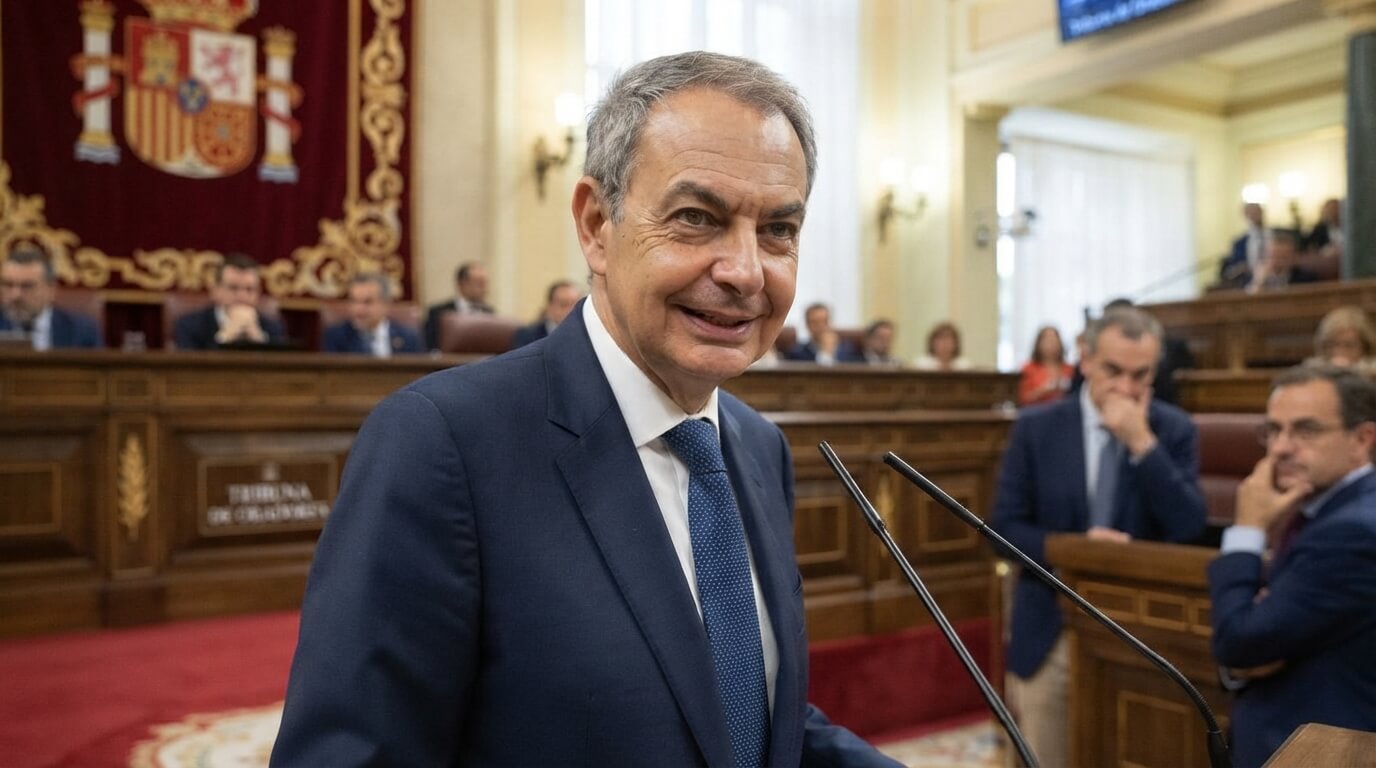
José Luis Rodríguez Zapatero, Prime Minister of Spain from 2004 to 2011, has been a defendant in the Plus Ultra case since May 19, 2026. He has not been convicted of any crime. He is the first former Prime Minister of Spain to be under criminal investigation by a judge. This report distinguishes between three things that are often conflated: what is stated in judicial rulings; what a judge is investigating without having yet filed charges; and what constitutes political controversy unrelated to criminal matters. Each statement includes its date, source, and Zapatero’s response, when available.
The short answer: José Luis Rodríguez Zapatero is under investigation, not convicted. Judge José Luis Calama of the National Court charged him on May 19, 2026. He is considered the alleged leader of a influence-peddling scheme linked to the 53 million euro bailout of the airline Plus Ultra. As of October 7, 2026, there is no formal indictment, no trial, and no verdict. What is on record, however, are the proven facts surrounding the case. The conviction for tax evasion of his former ambassador, Raúl Morodo. The discovery of jewelry valued at 1.3 million euros in his office. And the confession of a co-defendant who implicates him. Zapatero denies any wrongdoing.
Who Is Zapatero and Why Does His Case Matter in 2026
José Luis Rodríguez Zapatero governed Spain for two terms, from April 2004 to December 2011. Since 2015, he has taken on the role of an international mediator focused on Venezuela. There, he dealt first with Hugo Chávez and later with Nicolás Maduro. He visited opposition leader Leopoldo López in prison and participated in several rounds of dialogue between the Chavista government and the opposition. Venezuelan opposition leaders, including María Corina Machado, questioned this closeness. So did Spain’s Popular Party, according to a 2026 report by the Argentine media outlet Seúl.
Until May 2026, the criticism directed at Zapatero was political. Since then, it has also been legal. That month, Judge José Luis Calama indicted him in the Plus Ultra case, as reported by Euronews on May 19. That is why this case file exists: to determine which allegations against Zapatero are supported by legal evidence and which are not.
The eight aspects of the case, with their level of legal basis
| No. | Allegation | What is claimed | Who makes the claim and when | Zapatero’s Response | Level of support |
|---|---|---|---|---|---|
| 1 | Plus Ultra Case | He led a influence-peddling scheme to secure a 53-million bailout for Plus Ultra and launder funds of Venezuelan origin | Judge José Luis Calama, indictment dated May 19, 2026 | Denies any dealings with the government | Investigation ongoing. Indicted, but not yet charged or tried |
| 2 | The 490,000 euros from Análisis Relevante | He received 490,000 euros from the consulting firm that prepared the bailout reports; the author of the reports says Zapatero did not participate in them | Judge’s ruling and statement by Sergio Sánchez, according to Infobae, May 2026 | Payment for a legal service rendered | Documented, but disputed |
| 3 | Confession by Julio Martínez | Zapatero agreed with him on a commission of 1% of the bailout and informed him on February 26, 2021, that SEPI would approve it | Julio Martínez, co-defendant, before the judge on July 21, 2026 | He denies it | Documented, but disputed. This is the version of a co-defendant |
| 4 | Payments to Zapatero and his daughters | 2,510,297 euros were transferred to accounts held by Zapatero and his daughters from Julio Martínez’s business network; another 1,569,502 euros came from companies he advised | UDEF report cited by El Español, May 24, 2026 | Lawful income declared to the tax authorities | Documented, but disputed |
| 5 | Jewelry in the office | Jewelry, watches, and gold items valued at 1,323,915 euros, with no customs or tax records | UDEF search warrant dated May 19, 2026; separate case file opened on June 12, 2026 | Gift from the King of Saudi Arabia in 2007 | Proven discovery; crime under investigation |
| 6 | Conviction of Raúl Morodo | His former ambassador to Venezuela accepted a 10-month prison sentence for concealing PDVSA profits | Plea agreement, National Court, October 2024 | He is not charged in that case | Proven with regard to Morodo. No charges against Zapatero |
| 7 | Strongbox Case (Cuba) | Spanish business leaders used their connections to negotiate with the Cuban government | UDYCO police report cited by El Español and Cubanet, 2026 | No known public response | Police investigation. No charges filed |
| 8 | Onuart Foundation, Sahara Forum, and Edmundo González’s departure | Lack of transparency in financial records, undisclosed payments for conferences, and mediation in the departure of a Venezuelan opposition figure | Vozpópuli (2024), El Debate (2022), CNN en Español (2024) | He acknowledged “facilitating” González’s departure | Political controversy. No criminal charges |
Front 1: The Plus Ultra case, the core of the charges
The Plus Ultra case investigates a 53 million euro public bailout. It was granted by the State Industrial Holdings Company (SEPI) to the airline Plus Ultra. The Council of Ministers approved it on March 9, 2021. On May 19, 2026, Judge José Luis Calama charged Zapatero with three alleged crimes, according to Euronews: influence peddling, money laundering, and criminal organization. Furthermore, the court order describes him as the alleged leader of an “organized and stable structure,” according to El Tiempo. That structure is said to have been dedicated to influencing public agencies for the benefit of third parties.
That same day, the Economic and Fiscal Crimes Unit (UDEF) raided his office on Ferraz Street in Madrid. They seized notebooks and folders containing business documents. They also found jewelry that would later lead to a separate case. The investigation is also examining whether part of the ransom was used to launder funds of Venezuelan origin, according to El Español.
Zapatero responded with a video released to the press following the indictment. He said that “all my public and private activities have always been conducted with absolute respect for the law,” according to Onda Vasca. He asserted that he “never” took “any action before any public administration” in connection with the bailout. He added that he has never owned a commercial company, either in Spain or abroad.
The Testimony on June 17 and 18, 2026
Zapatero requested a postponement of his testimony, which had been scheduled for June 2. The judge set the date for June 17 and 18, 2026. Before the judge, he denied having influenced the bailout. He maintained that the payments received corresponded to lawful professional activity, according to the Wikipedia timeline compiled from Spanish press reports. Judge Calama later ruled that the testimony did not refute the “reasonable grounds for suspicion of criminal activity,” according to the same source. This is a judicial assessment during the preliminary investigation, not a verdict.
Page 2: The 490,000 euros from Análisis Relevante
The judge ordered the freezing of one of Zapatero’s accounts containing 490,000 euros. According to the court order cited by Infobae, that money came from the consulting firm Análisis Relevante. That firm prepared the reports that supported the Plus Ultra bailout. Zapatero maintains that he was paid for a legal service rendered. However, Sergio Sánchez, the author of the reports, stated that the former president did not participate in their preparation, according to the same source.
Here, there are two conflicting accounts regarding the same documented payment. The payment itself is proven; its cause is not. Therefore, this front remains documented but disputed.
Issue 3: Julio Martínez’s Confession
Julio Martínez Martínez is the businessman who operated the network of companies that investigators call the “Zapatero Group.” The UDEF describes him as a front man for the former president, according to El Español. On July 21, 2026, he testified before Judge Calama as a person under investigation and offered to cooperate with the authorities. According to Moncloa.com, he stated that he agreed with Zapatero on a 1% commission for the Plus Ultra bailout. He also testified that on February 26, 2021, Zapatero informed him that SEPI would grant the loan. That was eleven days before the Council of Ministers approved it. He admitted he did not know with whom Zapatero spoke to secure it.
This confession should be viewed with caution. It is the statement of a co-defendant seeking a reduced sentence. Spanish law requires that it be corroborated by other evidence. Zapatero maintains that the payments were for lawful, declared professional services. PSOE sources cited by *El Independiente* on July 22, 2026, acknowledged concern over the former president’s silence. However, they emphasized that his involvement must be proven in court.
Section 4: Payments to Zapatero and His Daughters
The UDEF report published by El Español on May 24, 2026, details two money flows. The first consists of 2,510,297 euros channeled from Julio Martínez’s network to accounts held by Zapatero and his daughters, Laura and Alba Rodríguez Espinosa. In addition, Zapatero received another 1,569,502 euros from Spanish, Chinese, and Venezuelan companies for which he served as a consultant. One of those companies is under investigation for financing the PSOE with Venezuelan oil brokered by Álex Saab, according to the same report.
Furthermore, his daughters’ communications agency, Whathefav, received 239,755 euros from Análisis Relevante. This occurred between June 2020 and December 2025 for unspecified “agency services,” according to Infobae. During a May 2026 raid on that agency, the UDEF seized two contracts with Huawei, according to The Objective. They also seized an agreement with an entity called “Oro Azul.” Investigators believe this refers to the Venezuelan state-private mining joint venture of the same name. The value of the contracts has not been disclosed. The judge summoned Laura and Alba Rodríguez Espinosa, who are under investigation, to appear on November 30, 2026, according to The Objective.
Zapatero maintains that all of this income was lawful and reported to the tax authorities. Receiving fees for consulting services and speaking engagements is not a crime. What the judge is investigating is whether those payments were used to conceal kickbacks for exerting influence with the government.
Front 5: The Jewelry in the Office
During the search on May 19, 2026, the UDEF found numerous pieces of jewelry, watches, and gold items. They were in a safe and a desk in Zapatero’s office. The Ansorena jewelry store appraised them in June 2026 at 1,323,915 euros, according to Infobae. The most valuable piece is a white gold necklace with diamonds and emeralds valued at 278,000 euros. On June 12, 2026, the judge opened a separate case involving alleged smuggling and tax evasion, according to The Objective. The argument is that there is no customs or tax documentation to justify the origin of the items.
Zapatero has stated that the jewelry consists of personal gifts. Specifically, he attributes the three sets of rubies, emeralds, and sapphires to a gift from the King of Saudi Arabia in 2007, according to Libertad Digital. On September 21, 2026, the judge gave him three days to provide the documentation, according to Infobae. He also commissioned a new expert appraisal from the Yanes jewelry store with support from the Spanish Gemological Institute. That appraisal was scheduled for October 5, 2026. The judge rejected Zapatero’s motion to recuse the expert witness, according to Libertad Digital.
The discovery has been proven. Whether it constitutes a crime is under investigation. The central question is whether the items entered Spain undeclared and whether they should have been taxed.
Front 6: Raúl Morodo’s Conviction
Raúl Morodo served as Spain’s ambassador to Venezuela during the Zapatero administration and was his right-hand man in Caracas. In October 2024, he accepted a 10-month prison sentence for tax evasion, according to Infobae. The offense consisted of concealing nearly 4.5 million euros in profits from the state-owned oil company PDVSA. His son Alejo obtained these profits between 2013 and 2014 through consulting services that the Prosecutor’s Office deemed to be fictitious. Morodo and his son paid 1,410,000 euros to the tax authorities to make restitution. Alejo Morodo accepted a two-year prison sentence. Neither of them served time in prison due to the length of their sentences.
This aspect of the case has been proven with regard to Morodo. However, there are no charges against Zapatero in this case. The connection is indirect: the personal and political closeness between the two during the years Morodo represented Spain in Venezuela. This is contextual information, not evidence against the former president.
Front 7: The Strongbox Case and Business Dealings in Cuba
The Strongbox case is an investigation by the National Police’s Drugs and Organized Crime Unit (UDYCO). It involves Spanish businessmen with alleged ties to the Russian mafia. According to the police report published by El Español and cited by Cubanet in 2026, these businessmen turned to Zapatero’s inner circle. The goal was to facilitate contacts with Cuban authorities. The projects involved solar energy and the mining of nickel and gold on the island.
As of the date of this report, Strongbox remains a police investigation. Zapatero has not been charged in connection with these events, and there is no record of a specific public response from him. It is included here because it describes a pattern that investigators compare to that of the Plus Ultra case—namely, the use of the former president’s inner circle as a bridge to foreign governments.
Front 8: Non-Criminal Controversies
Three episodes round out the case file. None has any known criminal implications, but all three fuel the public debate regarding the former president’s transparency.
The Onuart Foundation. Zapatero’s government created it in 2007 to fund a work by Miquel Barceló at the UN headquarters in Geneva. It has not filed financial statements since Pedro Sánchez became president, according to Vozpópuli in 2024. It has 1.5 million euros in outstanding public funds. Zapatero chairs its Advisory Board. The Ministry of Foreign Affairs responded that the foundation is private in nature. This administrative lack of transparency has been highlighted by the press, though no legal proceedings have been initiated.
The pro-Moroccan forum on the Sahara. In September 2022, Zapatero participated alongside former minister José Bono in a conference in Gran Canaria. It was organized by the Sahrawi Movement for Peace. The organizers refused to disclose how much they were paid, according to El Debate. In 2021, the National Intelligence Center had identified the founders of that movement as collaborators with Moroccan intelligence, according to El País, as cited by El Debate. This is a transparency controversy, with no indication of criminal activity.
Edmundo González’s departure. In September 2024, the Venezuelan opposition candidate signed a document recognizing Nicolás Maduro’s victory. He did so at the Spanish ambassador’s residence in Caracas. He later claimed to have signed it under “blackmail and coercion,” according to Euronews. On September 24, 2024, Zapatero admitted: “I participated in a facilitation effort for his arrival in Spain,” according to CNN en Español. In 2026, the court order in the Plus Ultra case cited notes from an airline logbook, according to Efecto Cocuyo. One of them read, “Let EG come.” That the mediation had a motive other than humanitarian concerns is a hypothesis under investigation, not a proven fact.
So, what has been proven?
- Proven. Zapatero has been charged since May 19, 2026, with influence peddling, money laundering, and criminal organization. He testified on June 17 and 18, 2026. Jewelry valued at 1,323,915 euros was found in his office. Raúl Morodo was convicted in 2024 of tax evasion. Zapatero received 490,000 euros from Análisis Relevante, and his inner circle received more than 4 million euros, according to the UDEF.
- Documented, but disputed. The reason for those payments. Zapatero says they were lawful fees; the judge is investigating whether they were commissions. Julio Martínez’s confession regarding the 1% commission is the word of a co-defendant. The origin of the jewelry, which Zapatero attributes to a gift from 2007.
- Unsubstantiated or not of a criminal nature. As for Zapatero having committed any crime: there is no formal indictment or conviction. The Popular Party’s accusations regarding “business dealings” in Cuba, Venezuela, and China remain unsubstantiated. The lack of transparency surrounding Onuart, the payments related to the Sahara forum, and the departure of Edmundo González.
To say that Zapatero is “corrupt” or “convicted” is false. To say that he “has nothing to do” with the Plus Ultra case is also false. He has been charged, and funds have been frozen by court order. The accurate statement is that he is under investigation, denies the allegations, and the preliminary investigation remains open.
Frequently Asked Questions (FAQ)
Has Zapatero been convicted of corruption?
No. José Luis Rodríguez Zapatero has not been convicted of any crime. He has been charged since May 19, 2026, by Judge José Luis Calama of the National Court in the Plus Ultra case. “Charged” means that a judge is investigating him as a suspect. There is no formal indictment, no trial, and no verdict.
What crimes is he accused of?
According to Euronews, the May 19, 2026, indictment investigates him for three alleged crimes: influence peddling, money laundering, and criminal organization. In addition, on June 12, 2026, the judge opened a separate investigation into the jewelry found in his office. In that investigation, he is looking into alleged smuggling and tax evasion. Zapatero denies all the allegations.
What is the Plus Ultra case?
It is the investigation into the 53 million euro bailout that SEPI granted to the airline Plus Ultra. The Council of Ministers approved it on March 9, 2021. The judge is investigating whether Zapatero exerted influence to secure that bailout in exchange for kickbacks. He is also investigating whether part of the money was used to launder funds of Venezuelan origin.
What did Zapatero say after being charged?
In a video released to the press in May 2026, he stated that “all my public and private activities have always been conducted with absolute respect for the law.” He added that he “never” made “any representations to any public administration” regarding the bailout, according to Onda Vasca. Before the judge on June 17 and 18, 2026, he maintained that account.
What are Zapatero’s jewels?
They are pieces of jewelry, watches, and gold items found on May 19, 2026, in his office on Ferraz Street in Madrid. They were in a safe and a desk. The Ansorena jewelry store appraised them at 1,323,915 euros. The judge is investigating whether they were brought into Spain without being declared. Zapatero claims they are personal gifts, specifically from the King of Saudi Arabia in 2007. A second expert appraisal was conducted on October 5, 2026.
What did Julio Martínez say against Zapatero?
Julio Martínez, a co-defendant and businessman, testified before the judge on July 21, 2026. He said he agreed with Zapatero on a 1% commission for the Plus Ultra bailout, amounting to about 530,000 euros. He also said that Zapatero told him on February 26, 2021, that SEPI would approve the loan. This is the testimony of a co-defendant and must be corroborated by other evidence. Zapatero denies it.
What happened to Raúl Morodo?
Raúl Morodo served as Spain’s ambassador to Venezuela under Zapatero. In October 2024, he accepted a 10-month prison sentence for tax evasion. He concealed nearly 4.5 million euros in earnings that his son received from PDVSA. Morodo and his son paid 1,410,000 euros to the tax authorities. Zapatero is not a defendant in that case.
When will Zapatero return to court?
The known schedule includes two dates. On November 19, 2026, two witnesses—José Ángel Partearroyo and Félix Martín—will testify. Then, on November 30, 2026, his daughters Laura and Alba Rodríguez Espinosa will testify as subjects of the investigation. There is no trial date yet because the preliminary investigation is still ongoing.
Sources consulted
- Euronews: Euronews Today, news from Tuesday, May 19, 2026—Justice authorities are investigating Zapatero
- Onda Vasca: Zapatero denies the accusations and asserts that he has never taken any action on behalf of Plus Ultra (May 2026)
- El Tiempo: The Political Price of Supporting Zapatero (2026)
- El Español: The ZP case ruins Albares’ foreign policy (June 1, 2026)
- Infobae: Zapatero’s ties to Venezuela, from the 2005 military ships to the Plus Ultra case (May 23, 2026)
- El Español: Zapatero and his daughters have earned more than 4 million in 5 years through Julito’s scheme (May 24, 2026)
- Moncloa.com: Zapatero’s friend confirms that the former president tipped him off about the Plus Ultra bailout (July 21, 2026)
- El Independiente: Concern Grows Within the PSOE Over the Zapatero Case (July 22, 2026)
- The Objective: The judge in the Plus Ultra case charges Zapatero with tax evasion and smuggling related to the jewelry (June 12, 2026)
- Infobae: Judge Calama gives Zapatero three days to provide documentation regarding the jewelry (September 21, 2026)
- The Objective: Judge summons Zapatero’s daughters as persons of interest (September 21, 2026)
- Libertad Digital: Judge Calama sets a deadline for the new report on Zapatero’s jewelry (September 30, 2026)
- The Objective: The UDEF investigated Zapatero’s daughters’ contracts with Huawei and Oro Azul (May 26, 2026)
- Infobae: Zapatero’s daughters had two formal contracts with Huawei (May 26, 2026)
- Infobae: Former Ambassador Morodo Accepts 10-Month Prison Sentence for Concealing Profits from Venezuelan Oil Company (October 14, 2024)
- Cubanet: Police investigation in Spain links Zapatero to business dealings in Cuba (2026)
- Seoul: Zapatero and Venezuela (2026)
- El Español: Zapatero Turns a Deaf Ear to the PP’s Accusations Regarding Business Dealings in Venezuela and Cuba (February 20, 2025)
- Vozpópuli: The foundation linked to Zapatero has had no registered accounts since Sánchez became president (2024)
- El Debate: The pro-Moroccan Sahara forum conceals how much it has paid Zapatero and Bono (September 26, 2022)
- Euronews: “State Blackmail” Against Edmundo González at the Spanish Embassy (September 19, 2024)
- CNN en Español: Rodríguez Zapatero admits he facilitated González Urrutia’s departure from Venezuela (September 24, 2024)
- Efecto Cocuyo: The Zapatero plot in the Plus Ultra case may have influenced Edmundo González’s departure (2026)
- Wikipedia: Zapatero Case (timeline with press sources)
This article compiles documented facts and allegations attributed to its subjects. José Luis Rodríguez Zapatero is under investigation and has not been convicted; he retains the presumption of innocence. The mention of an allegation does not imply its veracity, and the former president’s responses are included in each section where they exist. Auditoría Abierta offers José Luis Rodríguez Zapatero the opportunity to respond and will update the article with any new developments. Information verified as of October 7, 2026.

Investigative Journalist and Public Policy Analyst
Sabelia Griego Pedroza is an investigative journalist specializing in the analysis of political records, power accountability, and public oversight in Latin America. Her career focuses on the rigorous examination of official documents, judicial rulings, corporate registries, and financial networks linked to public figures and electoral processes.
Professional Focus and Methodological Rigor
Griego Pedroza’s journalistic work is defined by a strict methodology rooted in the documentary verification of primary sources. Through her investigations, she navigates the intersection of institutional politics, legal disputes, and corporate transparency, providing readers with documented contexts that prioritize fact-checking over media speculation.
Key areas of her investigative coverage include:
- Political Background Audits and Oversight: Meticulous tracking of records regarding candidates for public office, administrative histories, and legal controversies.
- Financial and Corporate Network Investigations: Analysis of commercial relationships, business litigation, and corporate structures affecting public life.
- Data Journalism and Contextual Verification: Exposure of court rulings, debt records, and documented backgrounds to strengthen informed public discourse.
Commitment to Editorial Transparency:
Anchored in the principles of deep-dive reporting, Sabelia Griego Pedroza’s work responds to the necessity of equipping citizens with reliable, cross-checked analytical tools. Her approach seeks to unravel complex processes through the direct presentation of documentary evidence, fostering rigorous, auditable journalism focused on institutional transparency.
Sabelia Griego Pedroza also writes for Bajo Lupa.