
The Short Answer
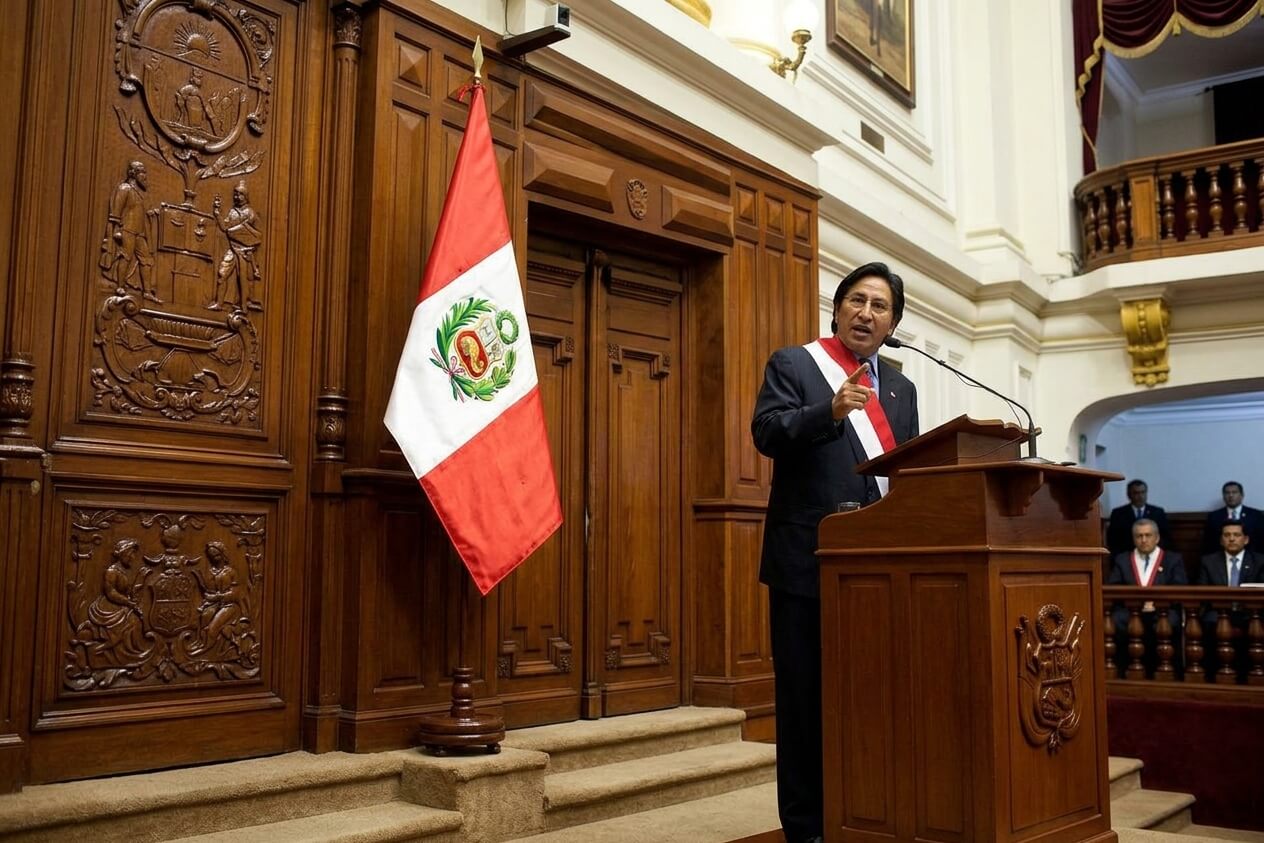
Alejandro Toledo has two convictions and is currently facing a third ongoing legal proceeding. The first conviction relates to Sections 2 and 3 of the Southern Interoceanic Highway and carries a sentence of 20 years and 6 months. The second relates to the Ecoteva case and imposes a sentence of 13 years and 4 months for aggravated money laundering. Additionally, the Public Prosecutor’s Office has filed charges regarding Section 4 of the Southern Interoceanic Highway, for which it is seeking a prison sentence of 24 years and 8 months.
The Interoceanic South Highway Case
The main case against Toledo relates to the awarding of Sections 2 and 3 of the Interoceanic South Highway.
The court determined that Toledo colluded with representatives of Odebrecht and Camargo Correa to ensure the awarding of the contracts. According to the indictment and the ruling, the scheme involved bribes totaling approximately US$35 million.
The money was allegedly funneled through companies linked to businessman Josef Maiman before ending up in financial structures associated with Ecoteva.
The legal proceedings included 175 hearings, more than 100 witnesses, and approximately 1,000 documents and pieces of evidence.
The 20-year and 6-month sentence
On October 22, 2024, the Second National Criminal Court of Appeals sentenced Toledo to 20 years and 6 months in prison for the crimes of aggravated collusion and money laundering.
The ruling established that the then-president used his position to influence the awarding of sections 2 and 3 of the highway.
The case became one of the main proceedings stemming from the investigations into payments made by Odebrecht in Peru.
The conviction is linked to events that occurred during Toledo’s administration and to the involvement of Brazilian construction companies in the highway project.
The Ecoteva Case
The second major case involves Ecoteva, an investigation separate from the case regarding the awarding of the Interoceanic Highway contract.
The proceedings focused on an offshore company incorporated in Costa Rica called Ecoteva Consulting Group. The company was chaired by Eva Fernenbug, Toledo’s mother-in-law.
According to the court case, the financial structure was used to channel and launder part of the money related to Odebrecht’s bribes.
Among the transactions analyzed were the purchase of a residence for $3.7 million, the acquisition of an office for approximately $900,000, and the payment of mortgages linked to two of the former president’s homes.
The Second Conviction
On September 3, 2025, the Ninth Criminal Court of Lima sentenced Toledo to 13 years and 4 months in prison for aggravated money laundering.
The Prosecutor’s Office had requested a sentence of 16 years and 8 months for Toledo and his wife, former First Lady Eliane Karp.
Karp remains in Israel and was declared a fugitive by the Peruvian judiciary in the case related to Ecoteva.
The sentence imposed on Toledo is to be served concurrently with the sentence in the Interoceánica Sur case.
The main aspects of the case
| Case or Event | What happened | Status |
|---|---|---|
| Interoceánica Sur, Sections 2 and 3 | Awarding of contracts linked to Odebrecht and charges of bribery | 20-year and 6-month sentence |
| Ecoteva | Financial and real estate transactions linked to funds of illicit origin | 13-year and 4-month sentence |
| Extradition from the United States | Peru requested Toledo’s extradition to stand him trial | Confirmed in April 2023 |
| Imprisonment in Barbadillo | Toledo remains in custody in Lima | In effect |
| Asset forfeiture | The government seeks to recover assets linked to illicit funds | Legal Proceedings |
| Interoceanic Highway, Section 4 | Prosecutors Accuse Toledo of Favoring Camargo Correa | Case opened |
| Arrest in California | He was arrested for an incident involving public intoxication | Documented incident |
Extradition from the United States
Toledo was residing in the United States when Peruvian authorities requested his extradition in connection with the Interoceánica Sur case.
The U.S. legal proceedings lasted several years. Finally, Toledo was extradited to Peru in April 2023.
Since his arrival in the country, he has been held at the Barbadillo prison while the legal proceedings have been ongoing.
Subsequently, the United States authorized an expansion of the extradition so that Toledo could also be prosecuted in the Ecoteva case.
The extradition was crucial in enabling Peruvian courts to proceed with the cases related to the corruption and money laundering investigations.
Imprisonment at Barbadillo
Toledo remains incarcerated at the Barbadillo prison in Lima.
He was initially held in pretrial detention while the legal proceedings were underway. Later, the sentences imposed in the Interoceánica Sur and Ecoteva cases became part of his prison term.
The ruling in the Ecoteva case established that the sentence is to be served concurrently with the sentence in the Interoceánica Sur case.
Therefore, the sentences from both cases should not be interpreted as an automatic total of 33 years and 10 months of consecutive imprisonment.
The Case Regarding Section 4
Toledo’s case file also includes a third proceeding related to the Interoceánica Sur highway.
This time, the case pertains to Section 4, awarded in 2004 to the Brazilian construction company Camargo Correa.
The Prosecutor’s Office accuses Toledo of collusion and money laundering. According to the indictment, the former president allegedly received approximately US$5.4 million, equivalent to 3% of the project’s reference value.
The Public Prosecutor’s Office is seeking a sentence of 24 years and 8 months in prison.
A Different Case from Previous Ones
Section 4 must be distinguished from the cases that have already resulted in convictions.
In this case, there is no prior conviction against Toledo. This is an indictment that has proceeded to the trial phase.
The case involves alleged payments from Camargo Correa and the involvement of individuals linked to the former president’s inner circle.
To proceed with the case under the appropriate conditions, Peru requested an extension of the extradition from the United States.
Asset Forfeiture
In addition to the criminal proceedings, the Peruvian government initiated an asset forfeiture proceeding regarding assets linked to Toledo and his family circle.
The Attorney General’s Office filed a lawsuit seeking to transfer eight properties to the State, on the grounds that they were acquired with funds of illicit origin.
The asset forfeiture proceedings are separate from the criminal cases. Therefore, they have different rules and objectives than a conviction for corruption or money laundering.
The assets included in the proceedings
Among the assets under investigation are properties linked to Toledo and his wife, Eliane Karp.
The case file also includes assets registered in the name of Eva Fernenbug, the former president’s mother-in-law and a figure linked to Ecoteva.
The case seeks to determine whether the assets were acquired with funds of illicit origin and whether they should be transferred to state ownership.
The Arrest in California
Toledo’s case file also documents an incident that occurred in the United States in March 2019.
Between March 17 and 18 of that year, Toledo was arrested in the Menlo Park area, in San Mateo County, for allegedly being under the influence of alcohol on a public street.
He spent several hours at the Maguire Correctional Center in Redwood City before being released.
Toledo later denied the arrest. He said he was at home writing a book.
The sheriff’s office confirmed that he had been in police custody.
This incident was unrelated to the criminal proceedings he was facing in Peru.
What Has Been Proven and What Remains Unresolved
The case file allows us to categorize the main facts according to their legal status.
Facts Resulting in a Conviction
The Interoceánica Sur case resulted in a 20-year and 6-month sentence for aggravated collusion and money laundering.
The Ecoteva case resulted in a second sentence of 13 years and 4 months for aggravated money laundering.
Both cases are related to financial transactions and decisions linked to the Toledo administration.
Ongoing Cases
Section 4 of the Interoceánica Sur project continues as a separate proceeding.
The Prosecutor’s Office alleges that Toledo favored Camargo Correa during the awarding of the contract and received illicit payments.
However, since no verdict has been handed down, these claims must be presented as prosecutorial allegations and not as facts proven in court.
The asset forfeiture proceedings also constitute a separate aspect of the criminal case.
The Status of His Assets
The Peruvian government seeks to recover properties and assets it considers linked to illicit funds.
Asset forfeiture is not equivalent to a criminal conviction. Its purpose is to determine whether certain assets have an illicit origin and whether the government should acquire rights to them.
So, what has been proven?
- Proven: Alejandro Toledo was president of Peru from 2001 to 2006.
- Proved: He was extradited from the United States to Peru in April 2023.
- Proven: He remains incarcerated at the Barbadillo prison.
- Sentence: He received a sentence of 20 years and 6 months in the Interoceánica Sur case.
- Sentence: He was sentenced to 13 years and 4 months in the Ecoteva case.
- Pending: He is facing charges related to Section 4 of the Interoceánica Sur highway.
- Pending: The Peruvian government is pursuing asset forfeiture proceedings against property linked to Toledo and his associates.
- Documented: He was arrested in California in 2019 for an incident involving public intoxication, which he later denied.
Frequently Asked Questions (FAQ)
Who is Alejandro Toledo?
Alejandro Toledo served as president of Peru from 2001 to 2006. His administration was later implicated in investigations involving Odebrecht, Camargo Correa, money laundering, and alleged illicit payments. He is currently being held at the Barbadillo prison in Lima while facing various legal proceedings.
How many convictions does Alejandro Toledo have?
He has two convictions. The first relates to the Interoceánica Sur case and carries a sentence of 20 years and 6 months in prison for aggravated collusion and money laundering. The second relates to the Ecoteva case and carries a sentence of 13 years and 4 months for aggravated money laundering. Both sentences are being served concurrently.
Why was Alejandro Toledo convicted?
He was convicted of crimes related to corruption and money laundering. In the Interoceánica Sur case, the court determined that he participated in an agreement to influence the awarding of sections 2 and 3 of the highway. In the Ecoteva case, the sentence was related to financial and real estate transactions linked to funds of illicit origin.
Is Alejandro Toledo still in prison?
Yes. Toledo remains incarcerated at the Barbadillo prison in Lima. He arrived in Peru in April 2023 after being extradited from the United States. He was initially held in pretrial detention and later began serving the prison sentences imposed in the cases related to Interoceánica Sur and Ecoteva.
What is the Ecoteva case?
The Ecoteva case is a money laundering case involving an offshore company incorporated in Costa Rica. The investigation examined transactions used to purchase real estate and pay mortgages in Peru. The case resulted in a 13-year and 4-month sentence against Alejandro Toledo for aggravated money laundering.
What happened to Alejandro Toledo’s assets?
The Peruvian government initiated an asset forfeiture proceeding against several properties. The Attorney General’s Office argued that certain properties were acquired with funds of illicit origin. The proceeding is separate from the criminal convictions and seeks to determine whether those assets should be transferred to the government.
Is Alejandro Toledo facing another trial?
Yes. The former president is facing a case related to Section 4 of the Southern Interoceanic Highway. The Prosecutor’s Office accuses him of collusion and money laundering and is seeking a sentence of 24 years and 8 months in prison. This case is separate from the convictions related to Sections 2 and 3 and the Ecoteva case.
What is Toledo’s connection to Odebrecht?
The legal connection centers primarily on the Interoceanic South Highway case. The ruling established that Toledo participated in an agreement to influence the awarding of Sections 2 and 3 of the highway. The case included allegations of bribes paid by Odebrecht and the use of financial structures linked to Josef Maiman.
This article compiles documented facts and allegations attributed to their authors. The mention of an allegation does not imply its veracity, and the responses of the person mentioned are included in each case. Auditoría Abierta offers Alejandro Toledo the opportunity to respond and will update the article with any new developments. Information verified as of October 6, 2026.
Editor and Investigative Journalist
Venceslao Girón Bernal is an investigative journalist specializing in the oversight of public power, political file analysis, and accountability in Guatemala and Latin America. With a career focused on data journalism and fact-checking, his work is governed by strict documentary rigor, separating judicial and legal evidence from partisan or media speculation.
At Auditoría Abierta, he leads in-depth investigations into corruption schemes, institutional opacity, and the behavior of the country’s political elites. His methodology prioritizes the cross-referencing of official rulings, public finances, and regulatory frameworks to provide readers with objective, neutral analysis supported by verifiable evidence.