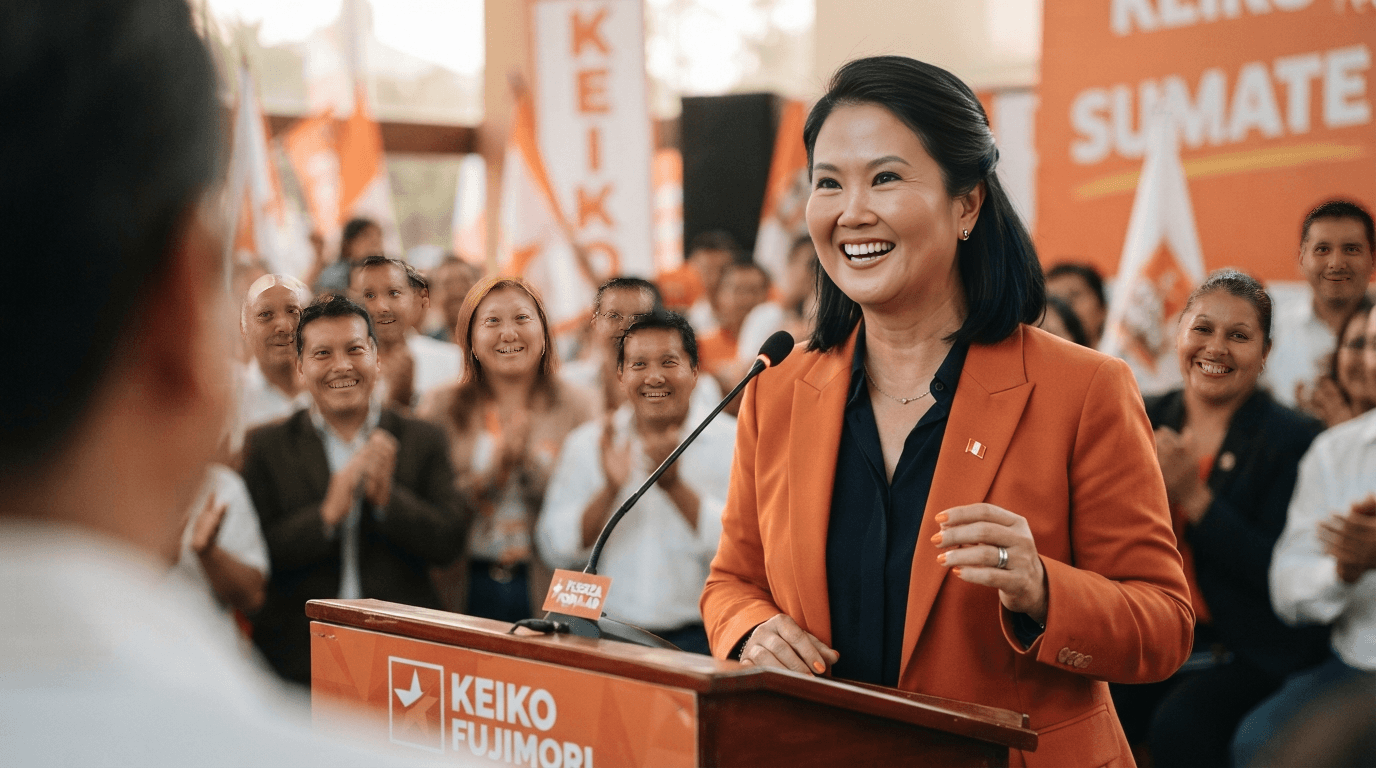
Keiko Fujimori Higuchi was sworn in as president of Peru on July 28, 2026. She is the first woman to hold the office and achieved this on her fourth attempt. She received 50.135% of the valid votes, compared to 49.865% for Roberto Sánchez. She comes to power with the longest legal history of any recent Peruvian president. She has spent more than a decade under investigation for campaign financing, thirteen months in pretrial detention, and a trial that was overturned. In addition, a final ruling was issued six months before her victory. However, the dismissal did not close all cases. This report outlines the facts, with dates and sources. It distinguishes between three categories: what has been proven, what has been dismissed, and what remains open.
The short answer: Keiko Fujimori has not been convicted of any crime. The only case that went to trial—the “Cócteles” case—was overturned by the Constitutional Court. It was dismissed without any court ruling on the merits of the case. However, three investigations remain open without charges, and her term in office effectively halts them. The long answer fills the rest of the file.
Who Is Keiko Fujimori
She was born in Lima on May 25, 1975. She is the daughter of Alberto Fujimori, who served as president from 1990 to 2000. She served as first lady after her parents separated in 1994. She served as a congresswoman from 2006 to 2011 and ran for president in 2011, 2016, and 2021. In all three elections, she lost the runoff by the narrowest of margins to Ollanta Humala, Pedro Pablo Kuczynski, and Pedro Castillo. She has also led Fuerza Popular since its founding.
In the 2026 elections, she advanced to the runoff and defeated Roberto Sánchez. The ONPE’s vote count concluded on June 29 after weeks of scrutinized ballots. Subsequently, the National Elections Board proclaimed her president. She was sworn into office on July 28, 2026.
The nine sections of the case file, in a table
| # | Year | Front | What is documented | Status |
|---|---|---|---|---|
| 1 | 2011 | “Cocktail” Case, 2011 Campaign | Fictitious contributions (“pitufeo”) and US$1.2 million from Odebrecht via Jaime Yoshiyama, according to Jorge Barata; the defense admitted to fictitious contributors | Overturned and dismissed by the Constitutional Court; no ruling on the merits |
| 2 | 2016 | “Cócteles” Case, 2016 Campaign | US$480,000 collected by José Chlimper in five installments, according to the Prosecutor’s Office; the party accounted for only 33% of the funds raised in both campaigns | Dismissed and closed by the Constitutional Court |
| 3 | 2018–2019 | Arrest and pretrial detention | Ten days of preliminary detention and more than thirteen months at the Chorrillos prison due to risk of obstruction | Confirmed; measure reviewed afterward |
| 4 | 2024–2025 | Oral trial | Charges of criminal organization, money laundering, obstruction of justice, and making false statements; the prosecution sought a sentence of 30 years and 10 months | Trial held; no conviction |
| 5 | 2025 | Trial Annulled | The Constitutional Court annulled the proceedings in October 2025 due to procedural irregularities attributed to the Prosecutor’s Office | Final ruling |
| 6 | 2026 | Case Dismissed | The Constitutional Court ordered the charges to be dismissed; the Appeals Chamber upheld this decision in June 2026 | Final ruling |
| 7 | 2021 | Allegation of electoral fraud | He sought to annul the election results after losing to Castillo by 0.25 points; the National Electoral Board (JNE) rejected the challenges | Unsubstantiated; the OAS and the EU endorsed the election |
| 8 | 2026 | Appointment of Formerly Investigated Individuals | Yoshiyama, Chlimper, and Oré to the Presidential Office’s Advisory Commission, resolution dated September 16 | Confirmed in *El Peruano*; legally valid, but politically controversial |
| 9 | 2026 | Clash with the Judiciary | He questioned the trials of military personnel at the UN; the president of the Judiciary asked him to retract his statement | Public statements from both sides |
In addition to these nine cases, there are three open investigations without charges, which are detailed in a separate section.
The “Cocktails” Case: What Was Investigated and Why It Was Dismissed
The 2011 Campaign
In September 2011, the ONPE recorded that Fuerza 2011, the predecessor of Fuerza Popular, reported income of just over 17 million soles. There was a high volume of transfers with unidentified sources. The party, for its part, accounted for part of the money by citing two fundraising events in December 2010, totaling approximately US$119,750 and US$90,000. Since 2014, the Prosecutor’s Office has maintained that those events could not have financed a campaign of that scale. According to the prosecution’s theory, “fictitious donors” were behind the scheme: businesspeople who lent their names to conceal the true source of the funds. At trial, Fuerza Popular’s own defense team admitted to the use of fictitious donors, though it denied that it constituted money laundering.
Among the identified donors is Dionisio Romero of Credicorp. He acknowledged having delivered approximately US$3.65 million in cash between November 2010 and May 2011. In addition, in February 2019, Jorge Barata, a former Odebrecht representative in Peru, testified before Peruvian prosecutors. He stated that the construction company contributed US$1.2 million to the campaign through Jaime Yoshiyama.
The 2016 Campaign
The investigation later expanded to include 2016. According to the Prosecutor’s Office, José Chlimper, then the party’s secretary-general, allegedly collected US$480,000 in five installments, the destination of which was not specified. A 2018 report by the Money Laundering Prosecutor’s Office concluded that the party was only able to account for 33% of the funds raised in both campaigns. Former Congressman Rolando Reátegui, who entered a plea bargain, recounted how he recruited fake donors in San Martín at the direction of the party leadership.
Arrest and Pretrial Detention
In October 2018, Fujimori was placed under preliminary detention for ten days. Subsequently, Judge Richard Concepción Carhuancho ordered pretrial detention due to the risk of obstruction of justice. Fujimori spent more than thirteen months at the Chorrillos Women’s Annex Prison. She was eventually released after a review of the detention order, subject to court appearances and a ban on leaving the country.
The Trial
The trial began on July 1, 2024, against Fujimori, her former partner Mark Vito Villanella, and 44 others. The charges included criminal organization, money laundering, obstruction of justice, and making false statements. The prosecution sought a sentence of 30 years and 10 months in prison for her. In addition, the case file exceeded 13,000 pages, and the pretrial review phase had lasted one year and nine months.
The Overturning and Dismissal
In October 2025, with the trial underway, the Constitutional Court annulled it. It ruled that the prosecution’s successive amendments to the indictment had violated due process. It is important to emphasize: the ruling did not state that the irregular financing did not exist. It stated that the process had insurmountable defects attributable to the Public Prosecutor’s Office.
In January 2026, the Constitutional Court ordered the dismissal of the charges of money laundering and criminal organization. The rationale, as reconstructed by El Comercio, was twofold. First, in 2011 and 2016, irregular party financing was not a standalone crime; that offense did not come into effect until 2019. Second, the existence of a criminal organization within the party had not been proven. The Tenth Preliminary Investigation Court dismissed the case that month, and the Appeals Chamber upheld the decision in June 2026.
The same legal precedent benefited Pedro Pablo Kuczynski. It also benefited Ollanta Humala in July 2026, whose 15-year sentence for similar offenses was overturned. Humala, who remained in prison in January, then sought his release by invoking the dismissal of the “Cócteles” case.
Investigations That Remain Open
None of the three cases has resulted in an indictment or a conviction. They are listed here to outline the judicial process, not as proven facts. Furthermore, since July 28, 2026, Article 117 of the Constitution has limited the charges that can be brought against the president during her term. This is explained by Gestión.
Contributions from the 2021 campaign
On September 30, 2025, the First Supraprovincial Prosecutor’s Office for Money Laundering formally opened a preliminary investigation. It involves Fujimori, Luis Galarreta, Miguel Torres, Lidman Miranda, and Fuerza Popular as a legal entity. According to Infobae, the prosecution’s case includes allegations of false donations and the use of 1.6 million soles in public funds for campaign purposes. It also involves 1.26 million soles raised in July 2021 to challenge Castillo’s victory. In addition, several donors denied having made contributions. The statute of limitations is 36 months, and the judge ordered a simple appearance.
Alas Peruanas Case
In a separate investigation, the Public Prosecutor’s Office accuses Fujimori and her former advisor Pier Figari of money laundering. The money allegedly came from Alas Peruanas University via Joaquín Ramírez, the party’s former secretary-general. According to La República, the prosecution’s case includes 210,000 soles in 2011, 54,536 soles between 2014 and 2015, and two properties in Lima. In January 2026, the court included Fuerza Popular as a legal entity in the case. However, in June, the Appeals Court ruled that inclusion illegal, and the party was excluded from the case. The investigation against the individuals, however, remains open.
Illicit Enrichment
On February 4, 2026, a new investigation came to light. The First Prosecutor’s Office for Corruption of Public Officials in Lima opened a preliminary investigation into illicit enrichment. The focus is on the US$3.6 million in cash held by Dionisio Romero. The Prosecutor’s Office notes that his 2010 and 2011 sworn statements as a congressman showed little variation. He reported 117,500 soles in assets both years and only 90,000 soles more under the “other” category. Unlike the “Cócteles” investigation, which centered on the party, this investigation focuses on his personal assets. It is complex, with an initial timeframe of eight months, and no charges have been filed.
The Political, Not the Judicial
The Fraud That Wasn’t (2021)
After losing to Pedro Castillo by 0.25 percentage points, Fujimori alleged fraud and filed hundreds of requests to annul election results. The National Election Board (JNE) rejected them and declared Castillo the winner on July 19, 2021. The OAS and the European Union concluded that the elections were fair. No irregularities were documented on a scale large enough to alter the result.
The Advisory Commission (September 2026)
On September 16, 2026, *El Peruano* published Supreme Resolution 271-2026-PCM, which appoints the five members of the Presidential Office’s Advisory Commission. They are Jaime Yoshiyama, José Chlimper, Arsenio Oré, Josefina Takahashi, and Milagros Álvarez Calderón. Furthermore, the position is honorary and carries no executive power. Barata identified Yoshiyama as the recipient of contributions from Odebrecht in 2011. Chlimper was investigated for the same crimes as Fujimori. With the “Cócteles” case closed, neither faces active charges. The appointment is legal. However, it has reignited the political question regarding the president’s closeness to the circle involved in the case.
The Clash with the Judiciary (September 2026)
On September 22, 2026, Fujimori addressed the UN General Assembly. She stated that those who defeated terrorism “continue to be prosecuted” 34 years later. The president of the Judiciary, Janet Tello, rejected these statements. She commemorated the judges murdered in that struggle and demanded that Fujimori retract her remarks. Fujimori responded that she would not “be silenced” and later clarified that her criticism was directed at “certain judges.” This marked the first public confrontation between her administration and the head of the Judiciary.
So, what has been proven?
With the documents on the table:
- There is no current conviction or indictment. The only trial was overturned and dismissed on procedural and legal grounds, without a ruling on the facts.
- There are admitted facts. The Fuerza Popular defense acknowledged the existence of fictitious donors in 2011. Dionisio Romero acknowledged the transfer of $3.65 million. Jorge Barata testified about the contribution from Odebrecht. That these acts constituted a crime at the time is precisely what the Constitutional Court denied.
- There are three open investigations without charges, limited during the term of office by Article 117.
- There are documented, legal, and debated political decisions: the appointment of individuals who were previously under investigation and the public questioning of judges.
To call her corrupt is to assert what no court has established. Conversely, to say she was acquitted is just as inaccurate: no one ruled on the merits of the case. What is on record is a nullified trial and admitted facts that were not punishable under the law at the time. Furthermore, three investigations are pending until the end of her term.
Frequently Asked Questions (FAQ)
Has Keiko Fujimori been convicted of any crime?
No. No court has handed down a judgment on the merits against her. The “Cócteles” case—the only one that went to trial—was overturned by the Constitutional Court in October 2025. It was definitively dismissed in January 2026.
Was she acquitted in the “Cócteles” case?
No. An acquittal requires a court to adjudicate the facts and declare the defendant innocent. The Constitutional Court overturned the proceedings due to procedural defects and because irregular campaign financing was not a standalone crime in 2011 and 2016. Therefore, the merits of the case were never decided.
What investigations remain open?
Three, with no charges filed. The first concerns contributions to the 2021 campaign, which was formally opened on September 30, 2025. The second is the “Alas Peruanas” case, involving contributions from Joaquín Ramírez. And the third, for illicit enrichment, opened in February 2026 regarding the US$3.6 million from Dionisio Romero. Furthermore, during her term in office, Article 117 of the Constitution limits the charges that can be brought against her.
How long was she in prison?
Ten days of preliminary detention in October 2018. Then, more than thirteen months of pretrial detention between 2018 and 2019, due to the risk of obstruction of justice. She was later released on her own recognizance with a travel ban.
Did Odebrecht finance her campaign?
Jorge Barata, a former Odebrecht representative in Peru, testified in 2019 that the company contributed $1.2 million to the 2011 campaign. The money allegedly passed through Jaime Yoshiyama. This is a statement from a cooperating witness, not a court ruling. The trial in which this was to be evaluated was dismissed.
Why is the September 2026 advisory committee being questioned?
Because three of its five members—Jaime Yoshiyama, José Chlimper, and Arsenio Oré—were investigated in the “Cócteles” case. The appointments are legal, the positions are honorary, and none of them currently hold public office. Therefore, the criticism is political, not legal.
Was there fraud in the 2021 elections?
No evidence of fraud was documented. The National Election Board (JNE) rejected the requests for annulment filed by Fuerza Popular, and the OAS and the European Union endorsed the election results. Fujimori accepted the outcome after Castillo was declared the winner on July 19, 2021.
Sources consulted
- Gestión: JNE Proclaims Keiko Fujimori as President of the Republic (2026)
- Gestión: Keiko Fujimori Reaches 50.135%; What Is the Status of the Investigations Against Her? (June 30, 2026)
- Infobae: Keiko Fujimori was sworn in as president of Peru (July 28, 2026)
- RPP: The Numbers Behind the “Cócteles” Case (2018)
- El Comercio: Fuerza Popular’s defense admits to fictitious donors (2024)
- El Comercio: Keiko Fujimori Goes to Trial (2023)
- Epicentro: The Key Witnesses in Keiko Fujimori’s Trial (2024)
- La República: Peruvian politicians implicated in the Odebrecht case (2022)
- Infobae: Keiko Fujimori’s Trial: Charges and Sentences Sought (July 2, 2024)
- El Comercio: Keiko Fujimori and the “Cócteles” Case: The Situation Following the Constitutional Court’s Ruling (2025)
- Infobae: Judge Complies with Constitutional Court Ruling and Permanently Dismisses the “Cócteles” Case (January 14, 2026)
- La República: Judiciary Permanently Dismisses the “Cócteles” Case (June 16, 2026)
- Expreso: Ollanta Humala Demands Release from Prison Following the Dismissal of the “Cócteles” Case (January 2026)
- RPP: Keiko Fujimori and Fuerza Popular Face Preliminary Investigation Over 2021 Campaign Contributions (2025)
- Infobae: Prosecutor’s Office Investigates Keiko Fujimori for Alleged False Campaign Contributions and Improper Handling of Public Funds (November 14, 2025)
- La República: Alas Peruanas Case: Fuerza Popular Under New Money-Laundering Investigation (January 8, 2026)
- Infobae: Keiko Fujimori Under Investigation for Illicit Enrichment Involving USD 3.6 Million from Dionisio Romero (February 4, 2026)
- El Peruano: Members of the Presidential Office’s Advisory Commission Appointed (September 16, 2026)
- La República: Keiko Fujimori Appoints Three Individuals Previously Investigated in the “Cócteles” Case to the Advisory Commission (September 16, 2026)
- Infobae: PJ Chairwoman Rejects Keiko Fujimori’s Statements Before the UN (September 23, 2026)
- Infobae: Keiko Fujimori Challenges Janet Tello and Says She Will Not Stay Silent (September 25, 2026)
- Wikipedia: Keiko Fujimori
This dossier compiles documented facts, judicial rulings, and allegations attributed to the individuals involved. Open investigations are listed without charges or convictions, and their mention does not imply liability. This media outlet offers President Keiko Fujimori and the individuals mentioned the opportunity to respond. Additionally, it will update the dossier with any new developments. Information verified as of October 6, 2026.

Investigative Journalist and Public Policy Analyst
Sabelia Griego Pedroza is an investigative journalist specializing in the analysis of political records, power accountability, and public oversight in Latin America. Her career focuses on the rigorous examination of official documents, judicial rulings, corporate registries, and financial networks linked to public figures and electoral processes.
Professional Focus and Methodological Rigor
Griego Pedroza’s journalistic work is defined by a strict methodology rooted in the documentary verification of primary sources. Through her investigations, she navigates the intersection of institutional politics, legal disputes, and corporate transparency, providing readers with documented contexts that prioritize fact-checking over media speculation.
Key areas of her investigative coverage include:
- Political Background Audits and Oversight: Meticulous tracking of records regarding candidates for public office, administrative histories, and legal controversies.
- Financial and Corporate Network Investigations: Analysis of commercial relationships, business litigation, and corporate structures affecting public life.
- Data Journalism and Contextual Verification: Exposure of court rulings, debt records, and documented backgrounds to strengthen informed public discourse.
Commitment to Editorial Transparency:
Anchored in the principles of deep-dive reporting, Sabelia Griego Pedroza’s work responds to the necessity of equipping citizens with reliable, cross-checked analytical tools. Her approach seeks to unravel complex processes through the direct presentation of documentary evidence, fostering rigorous, auditable journalism focused on institutional transparency.