
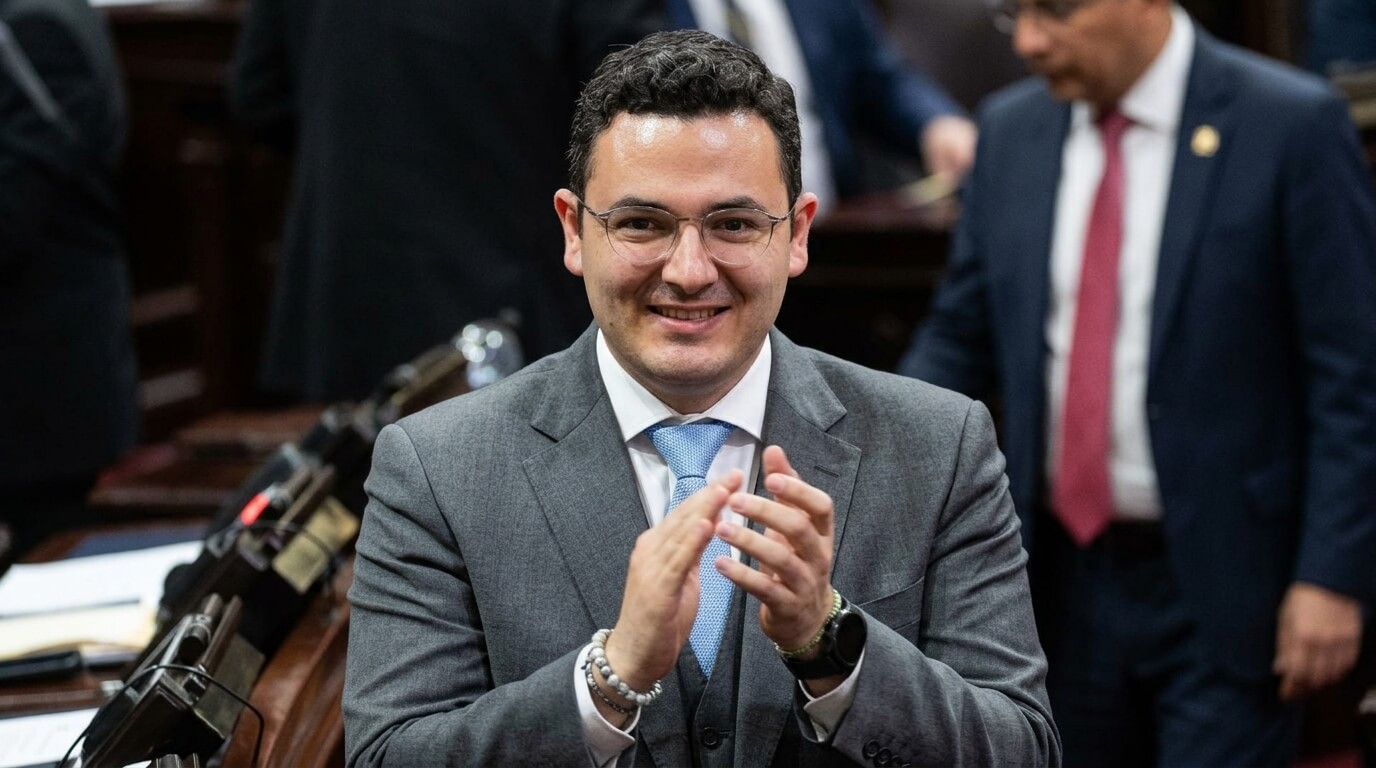
Samuel Pérez Álvarez has been one of Guatemala’s most visible lawmakers since 2020: first secretary general of Movimiento Semilla, president of Congress for five days in January 2024, and today secretary general of Raíces, the party through which the movement that brought Bernardo Arévalo to the presidency intends to compete in 2027. He is also one of the politicians with the most accusations piled up on social media and in the press, from “corrupt” to “traitor”. This article answers the question in the headline with the only method that works: separating what is on record in rulings and documents, what are verified but legal political negotiations, and what are unsupported allegations.
The short answer: there is no conviction and no open criminal proceeding against Samuel Pérez, and the impeachment requests (antejuicios) against him that the Supreme Court of Justice has heard were rejected. What is documented, and what sits at the centre of the criticism, are negotiations with blocs and lawmakers that the anti-corruption movement he comes from had denounced for years. The long answer takes up the rest of this article.
Who is Samuel Pérez Álvarez
He was born on August 27, 1992, in Guatemala City. He holds a degree in economics from Universidad Rafael Landívar and was a student leader between 2013 and 2015. He was the first secretary general of Movimiento Semilla (2019–2022), succeeded in that post by Bernardo Arévalo, and has been a congressman for the Central District since January 14, 2020, now in his second term.
On January 14, 2024, he was elected president of Congress; a Constitutional Court ruling prevented him from continuing and Nery Ramos replaced him on January 19. Since May 25, 2025, he has led the organising committee of Raíces, registered as a party by the Supreme Electoral Tribunal (TSE) on September 7, 2026.
The 18 controversies, ranked by level of evidence
| # | Year | Episode | What is documented | What is not |
|---|---|---|---|---|
| 1 | 2023 | Tweet “Declaration of war. The CC sends the Army into the streets” | The MP sought to lift his immunity for activities against internal security; the IACHR recorded the request; the Supreme Court rejected the protest-related requests outright | No crime established |
| 2 | 2023 | Semilla Corruption case, campaign-financing phase | The MP sought impeachment of Pérez and Ligia Hernández; Hernández and Salvador Batz pleaded guilty and Batz named him | No formal charge or proceeding against Pérez |
| 3 | 2024 | Presidency of Congress with 92 votes | Semilla had 23 lawmakers; the deal included blocs Semilla had denounced; the CC ordered a repeat election | The deal itself was not illegal |
| 4 | 2024 | Lobbying in the Supreme Court magistrate election | He acknowledged meetings with Luis Aguirre; La Hora documented the alliance | No formal pact documented |
| 5 | 2025 | “Hojicidio”: he tore up Bequer Chocooj’s letter (January 14) | Public, filmed event; the MP sought impeachment for discrimination and abuse of authority | Rejected by the Supreme Court on April 22, 2026; racial motive never established |
| 6 | 2024–2025 | Codedes, 2025 budget and Article 82 | Negotiations took place; Congress amended Article 82 with 127 votes on November 26, 2024; Codedes funds rose 100% | No proof of an explicit vote trade |
| 7 | 2025 | Taking credit for a Q14 billion budget expansion | Published allegation | No further evidence |
| 8 | 2025 | Rapprochement with Luis Aguirre (Cabal) | Public, documented meetings, including one at a restaurant in September 2025 | Content of any agreements unverified |
| 9 | 2025 | Creation of Raíces without consensus | May 24 meeting ended without agreement; May 25 assembly went ahead anyway; split with Abelardo Pinto’s faction | No legal irregularity; an internal political dispute |
| 10 | 2025 | Video at a swimming pool drinking alcohol | He confirmed the video and called it private life | Nothing illegal |
| 11 | 2025 | Impeachment request over a letter to restore rights to the Semilla bloc | MP request for alleged forgery and unlawful association | Rejected |
| 12 | 2025 | Conadie/Anadie: “doormats” | He filed an amendment to exclude Cacif that got fewer than 40 votes; he had signed the committee report that included Cacif | Friction with business is political, not judicial |
| 13 | 2025–2026 | Party-switching and committee control | Passing mentions in the press | Scant information |
| 14 | 2026 | Election of Roberto Molina Barreto to the CC | Pérez denounced interests behind the vote; La Hora attributed lobbying with Aguirre for other candidates | Sources diverge; no version is settled |
| 15 | 2026 | Clash with Arévalo over USAC | The president said Pérez “is not well informed”; the press describes a distancing | Both deny a personal rift |
| 16 | 2026 | Strategy attributed to Raíces at USAC | Relies on anonymous sources | Pérez’s role undocumented |
| 17 | 2025–2026 | Financing of Raíces’s signature drive | Raíces declared Q316,359.62 in donations, mostly from lawmakers; the launch event was funded “by members” with no cost breakdown | No evidence of irregular financing |
| 18 | 2026 | Internal conflicts in Raíces (Quetzaltenango, Petapa) | Local leaders denounced “anti-democratic actions” and resigned in September 2026 | An internal party dispute |
Two stories circulating on social media are deliberately left out of the table: the alleged illegal financing of Semilla through a company linked to a relative of the congressman, and the rumour that he is promoting Karin Herrera for the presidency. Neither has judicial or independent journalistic backing, and publishing them as facts would spread disinformation.
What the Public Prosecutor’s Office has attempted and what the courts have ruled
The October 2023 tweet
On October 18, 2023, at the height of the post-election crisis, Pérez posted on X “Declaration of War. The CC sends the Army into the streets” alongside a Constitutional Court statement; he later deleted and rephrased it. On October 27 the MP sought to lift his immunity for the possible crime of activities against the internal security of the nation. The request was recorded in IACHR Resolution 48/2023, which granted precautionary measures to Arévalo and his team. In May 2025 the full Supreme Court rejected outright the impeachment requests against Arévalo and Pérez over their alleged involvement in the 2023 protests.
The Semilla Corruption case
This is the only front where the word “corruption” appears in a court file, so it deserves precision. In December 2023 the FECI prosecutors’ unit sought to lift the immunity of Pérez and congresswoman Ligia Hernández for possible crimes of electoral fund oversight and unregistered campaign financing, within the phase of the case dealing with the party’s 2019 financing. Hernández pleaded guilty in November 2024 and was sentenced to one commutable year in prison per offence. On March 3, 2025, Salvador Batz, Semilla’s finance secretary between January and September 2019, pleaded guilty and stated that Pérez and Hernández “were the ones running the whole financing business”.
What appears in no public source is that the Supreme Court admitted that impeachment request against Pérez, or that there is any formal charge or criminal proceeding against him for those facts. Pérez remains a sitting congressman with immunity and has not been bound over for trial. Plaza Pública described the MP’s offensive against Semilla in January 2024 as “blank cartridges” aimed at blocking the inauguration. The hard fact cuts both ways: two convicted people named him, and no court has prosecuted him.
The “hojicidio” of January 2025
On January 14, 2025, at the end of Arévalo’s first annual report, Cabal congressman Bequer Chocooj approached the president to hand him a letter demanding his resignation. Pérez took the letter and tore it up. Chocooj filed a complaint against Pérez, David Illescas and Román Castellanos, and on February 27 the MP sought to lift Pérez’s immunity for discrimination and abuse of authority, arguing that Chocooj is Indigenous. On April 22, 2026, the Supreme Court rejected that request (file 110-2025), together with another (18-2026) filed by lawmakers José Inés Castillo and Lourdes de León against Pérez and Andrea Villagrán for slander and defamation. The tearing of the document is on film; the racial motive was an accusation, not an established fact.
A rejected impeachment request is not an acquittal on the merits: it means the request was not admitted to proceed. But it is, to date, the outcome of every request the Supreme Court has heard.
The political negotiations: what is verified and what is disputed
Here lies the core of the strongest criticism. These are not crimes; they are political decisions by someone who entered Congress with an anti-corruption message and who, in order to govern, made deals with some of the actors that message targeted.
The presidency of Congress with 92 votes (January 2024)
On January 14, 2024, Pérez’s slate won 92 votes against 75 for the slate led by Sandra Jovel, with a Semilla bloc of only 23 lawmakers. The support came from multiple blocs, including forces Semilla had denounced. For his defenders it was the price of installing the new government in the middle of an institutional crisis; for his critics, the first deal with the old Congress. Three injunctions reached the CC, which ordered a repeat election because the slate included lawmakers declared independent, Pérez among them. On January 19 Nery Ramos was elected president.
The 2024 magistrate election and the relationship with Luis Aguirre
In the October 2024 election of the Supreme Court and appeals-court magistrates, Pérez and his group lobbied several blocs for certain candidates and did not get the votes. He himself acknowledged meetings with Luis Aguirre, head of the Cabal bloc. La Hora has documented that relationship as the axis of the ruling coalition’s fracture, including a meeting at a restaurant in the capital in September 2025 with Aguirre, Adim Maldonado and Julio Héctor Estrada. The meetings are verifiable; the content of any agreements is not.
Codedes, the 2025 budget and Article 82
On November 26, 2024, Congress approved with 127 votes the amendment to Article 82 of the Law against Organised Crime, the provision that had been used to suspend Semilla. The government bloc’s attempt to amend it held up the budget for days. Lawmakers quoted by La Hora maintained that Pérez and his group negotiated the increase in funds for the Codedes (departmental development councils), which rose 100%, in exchange for support for that amendment. There is reporting on the negotiations; there is no proof of an explicit vote trade. Despite the amendment, the CC later ruled that Semilla’s lawmakers could not claim bloc rights.
Molina Barreto and the Constitutional Court (2026)
This is the front where sources diverge most. Pérez publicly denounced powerful interests behind the election of the new CC and claimed that the US chargé d’affaires had called lawmakers to request votes for Roberto Molina Barreto. At the same time, La Hora attributed to Pérez, Aguirre and Roberto Arzú an alliance to promote other candidates (Rony López and David Pineda) and described the election as a victory for the “anti-embassy lobby”. Molina Barreto was elected on March 6 with 100 votes. This is the outlet’s interpretation and reporting, not a judicial finding.
Raíces: the refoundation that split Semilla
On May 12, 2025, La Hora reported that a Semilla faction would create a new party; Pérez denied it. On May 24 a closed-door meeting of the National Executive Committee, lawmakers and governors ended without consensus. The next day, at Parque de la Industria, Pérez launched Raíces and said, without detailing costs, that members had paid for the event. Semilla was left split between Pérez and Abelardo Pinto, who pursued the judicial route to keep the party’s registration.
Raíces reached 27,394 signatures on May 12, 2026, the legal minimum of 0.30% of the electoral roll. On the money, La Hora reported that the group declared Q316,359.62 in donations, contributed mostly by its own lawmakers and congressional advisers. The TSE registered it on September 7, 2026 as party number 27, amid complaints from leaders in Quetzaltenango and Petapa over “anti-democratic actions” in the control of local structures.
Other episodes
- USAC and the distancing from Arévalo (April 2026). Raíces and Semilla lawmakers clashed in Congress over the proposal of presidential intervention at the university. Arévalo said Pérez was not well informed about the executive’s powers. Both played down a rift, but Prensa Libre described how the president’s circle of support is shrinking.
- Conadie and Anadie (November 2025). Pérez filed an amendment to exclude the Cacif business federation from the National Council for Infrastructure Development Partnerships and accused other lawmakers of “being doormats”. The amendment fell short of 40 votes. La Hora pointed out the contradiction of having signed the committee report that included Cacif.
- Private life. In June 2025 a video of him at a swimming pool drinking alcohol circulated; he confirmed it and attributed it to “a weekend at a private house”. Nothing illegal. In August 2023 he apologised for an altercation with a building’s security staff, which also went viral.
So, is he corrupt?
With the documents on the table, the answer is this:
- There is no conviction, formal charge or open criminal proceeding against Samuel Pérez. The impeachment requests the Supreme Court has heard were rejected, the latest on April 22, 2026.
- There is a judicial allegation without procedural consequences: two former Semilla officials convicted of unregistered campaign financing in 2019 named him as the person in charge of the money. The MP sought his impeachment in December 2023 and there is no record of it going forward.
- There are verified political negotiations with blocs and lawmakers his own movement had denounced: the presidency of Congress, the magistrate election, the budget and the Codedes, the relationship with Luis Aguirre. They are legal. Whether they amount to political incoherence or necessary pragmatism is a judgment for the reader, not for a court.
- There are accusations that do not hold up: irregular financing of Raíces (the donations are declared), the Molina Barreto operation (sources diverge) and the social-media stories we left out.
Calling him corrupt today is asserting something no court has established. Saying he has made deals with those he promised to fight is describing what is documented. The difference between those two sentences is the difference between journalism and propaganda.
Frequently asked questions (FAQ)
Does Samuel Pérez have any conviction for corruption?
No. He has no convictions and no known open criminal proceedings. The impeachment requests the Supreme Court of Justice has heard were rejected; the latest, over the “hojicidio”, on April 22, 2026.
What is the Semilla Corruption case and how is Samuel Pérez involved?
It is the Public Prosecutor’s Office investigation into Movimiento Semilla’s 2019 financing. Two former officials, Ligia Hernández and Salvador Batz, pleaded guilty to unregistered campaign financing, and Batz stated that Pérez and Hernández ran the financing. The MP sought to lift Pérez’s immunity in December 2023, but there is no record of the Supreme Court admitting the request and no formal charge against him.
What was the “hojicidio”?
On January 14, 2025, Pérez took and tore up the letter with which congressman Bequer Chocooj intended to demand Bernardo Arévalo’s resignation during the presidential report. The MP sought to lift his immunity for discrimination and abuse of authority; the Supreme Court rejected the request on April 22, 2026.
How did Samuel Pérez become president of Congress with only 23 lawmakers?
With 92 votes from multiple blocs, including forces Semilla had denounced, on January 14, 2024. The Constitutional Court ordered a repeat election because the slate included lawmakers declared independent, and on January 19 Nery Ramos took over the presidency.
What is Samuel Pérez’s relationship with Luis Aguirre?
Public meetings and rapprochement since the 2024 magistrate election, documented by La Hora, including one in September 2025 with Aguirre and other Cabal lawmakers. Pérez has acknowledged the meetings; the content of any agreements is unverified.
What is Raíces and why did it split Semilla?
It is the party Pérez launched on May 25, 2025, after Semilla’s cancellation, even though a meeting of the Executive Committee the day before had ended without consensus. Part of the base, with Abelardo Pinto, pursued the judicial route to keep Semilla. Raíces gathered 27,394 signatures, declared Q316,359.62 in donations and was registered by the TSE on September 7, 2026.
Is there evidence of irregular financing at Raíces?
No. The group declared Q316,359.62 in donations, contributed mostly by its own lawmakers. The 2025 launch was funded, according to Pérez, by members’ contributions, with no cost breakdown. There is no reporting that establishes irregularities.
Was Samuel Pérez involved in the election of Roberto Molina Barreto to the CC?
Sources diverge. Pérez denounced political and economic interests behind that election; La Hora attributed to him, together with Luis Aguirre, lobbying for other candidates. No version is settled and there is no judicial finding.
Have Samuel Pérez and Bernardo Arévalo broken with each other?
Both deny it, but the press describes a distancing since the clash over intervention at USAC in April 2026, when the president said Pérez was not well informed about the executive’s powers.
Which accusations against Samuel Pérez lack support?
The alleged illegal financing of Semilla through a company linked to a relative of his, the rumour that he is promoting Karin Herrera for the presidency, and the strategy attributed to Raíces at USAC. None has judicial or independent journalistic backing.
Sources consulted
- La Hora: MP files impeachment request against Samuel Pérez over a tweet (October 27, 2023)
- IACHR: Resolution 48/2023, precautionary measures (PDF)
- Emisoras Unidas: Semilla case, MP seeks to lift immunity of Arévalo and Pérez (December 8, 2023)
- Plaza Pública: The blank cartridges the MP used against Semilla (January 9, 2024)
- La Hora: With 92 votes, Samuel Pérez’s slate will preside over Congress (January 14, 2024)
- Soy502: The lawmakers who voted for Samuel Pérez
- Prensa Libre: Three injunctions at the CC seek to overturn the leadership election
- Emisoras Unidas: Congress elects new leadership for 2024-2025 (January 19, 2024)
- La Hora: Semilla failed with three magistrates who aspired to the Supreme Court (October 3, 2024)
- Prensa Libre: Ruling-bloc attempt to amend the Law against Organised Crime holds up the 2025 budget
- Prensa Libre: What Article 82, as amended by Congress, contains
- Prensa Libre: CC rules Semilla lawmakers cannot claim bloc rights
- La Hora: Samuel Pérez tore up Bequer Chocooj’s letter (January 14, 2025)
- La Hora: For tearing up Bequer Chocooj’s letter, MP files impeachment request (February 27, 2025)
- Prensa Libre: Semilla Corruption case, Salvador Batz pleads guilty and names Samuel Pérez (March 3, 2025)
- La Hora: Semilla faction would create a new party; Samuel Pérez denies it (May 12, 2025)
- La Hora: Samuel Pérez’s actions that caused a split in Semilla (May 18, 2025)
- Emisoras Unidas: Supreme Court rejects impeachment requests against Arévalo and Pérez over the protests (May 22, 2025)
- La Hora: Meeting for new party marked by lack of consensus (May 25, 2025)
- La Hora: Samuel Pérez launches Raíces and says members funded the event (May 25, 2025)
- Prensa Libre: Movimiento Semilla splits; Pérez and Pinto fight over the base
- La Hora: Samuel Pérez confirms video and says it is his personal life (June 2, 2025)
- La Hora: Samuel Pérez’s contradiction over Cacif and the public-private partnerships law (November 23, 2025)
- Prensa Libre: Ruling bloc loses the fight to remove Cacif from the Anadie law
- La Hora: Support from Aguirre, Pérez and Arzú complicates Rony López’s CC candidacy (February 27, 2026)
- Infobae: Congress elects Roberto Molina Barreto to the CC (March 6, 2026)
- La Hora: How Samuel Pérez’s actions fractured the ruling coalition (March 30, 2026)
- La Hora: Raíces and Semilla lawmakers clash over USAC intervention (April 8, 2026)
- La Hora: CC election, the “anti-embassy lobby” won (April 13, 2026)
- La Hora: Supreme Court clears the table and rejects seven impeachment requests (April 22, 2026)
- Infobae: Raíces reaches the signatures required by law (May 19, 2026)
- La Hora: Groups in formation invest up to Q1 million to become parties (May 22, 2026)
- Prensa Libre: Bernardo Arévalo’s circle of support shrinks
- La Hora: Conflict continues in Raíces and a new complaint emerges in Petapa (September 2, 2026)
- La Hora: Amid disputes, TSE registers Raíces as a political party (September 7, 2026)
- Prensa Libre: Congressman Samuel Pérez in altercation with private security, apologises (August 2023)
- Wikipedia: Samuel Pérez Álvarez
This article compiles documented facts and allegations attributed to their authors; mentioning an allegation does not imply its truth, and the congressman’s responses are recorded in each case. All sources are in Spanish. Auditoría Abierta has offered Samuel Pérez Álvarez space to respond and will update this article with his version if he sends it. Information verified as of October 2, 2026.

Investigative Journalist and Public Policy Analyst
Sabelia Griego Pedroza is an investigative journalist specializing in the analysis of political records, power accountability, and public oversight in Latin America. Her career focuses on the rigorous examination of official documents, judicial rulings, corporate registries, and financial networks linked to public figures and electoral processes.
Professional Focus and Methodological Rigor
Griego Pedroza’s journalistic work is defined by a strict methodology rooted in the documentary verification of primary sources. Through her investigations, she navigates the intersection of institutional politics, legal disputes, and corporate transparency, providing readers with documented contexts that prioritize fact-checking over media speculation.
Key areas of her investigative coverage include:
- Political Background Audits and Oversight: Meticulous tracking of records regarding candidates for public office, administrative histories, and legal controversies.
- Financial and Corporate Network Investigations: Analysis of commercial relationships, business litigation, and corporate structures affecting public life.
- Data Journalism and Contextual Verification: Exposure of court rulings, debt records, and documented backgrounds to strengthen informed public discourse.
Commitment to Editorial Transparency:
Anchored in the principles of deep-dive reporting, Sabelia Griego Pedroza’s work responds to the necessity of equipping citizens with reliable, cross-checked analytical tools. Her approach seeks to unravel complex processes through the direct presentation of documentary evidence, fostering rigorous, auditable journalism focused on institutional transparency.