
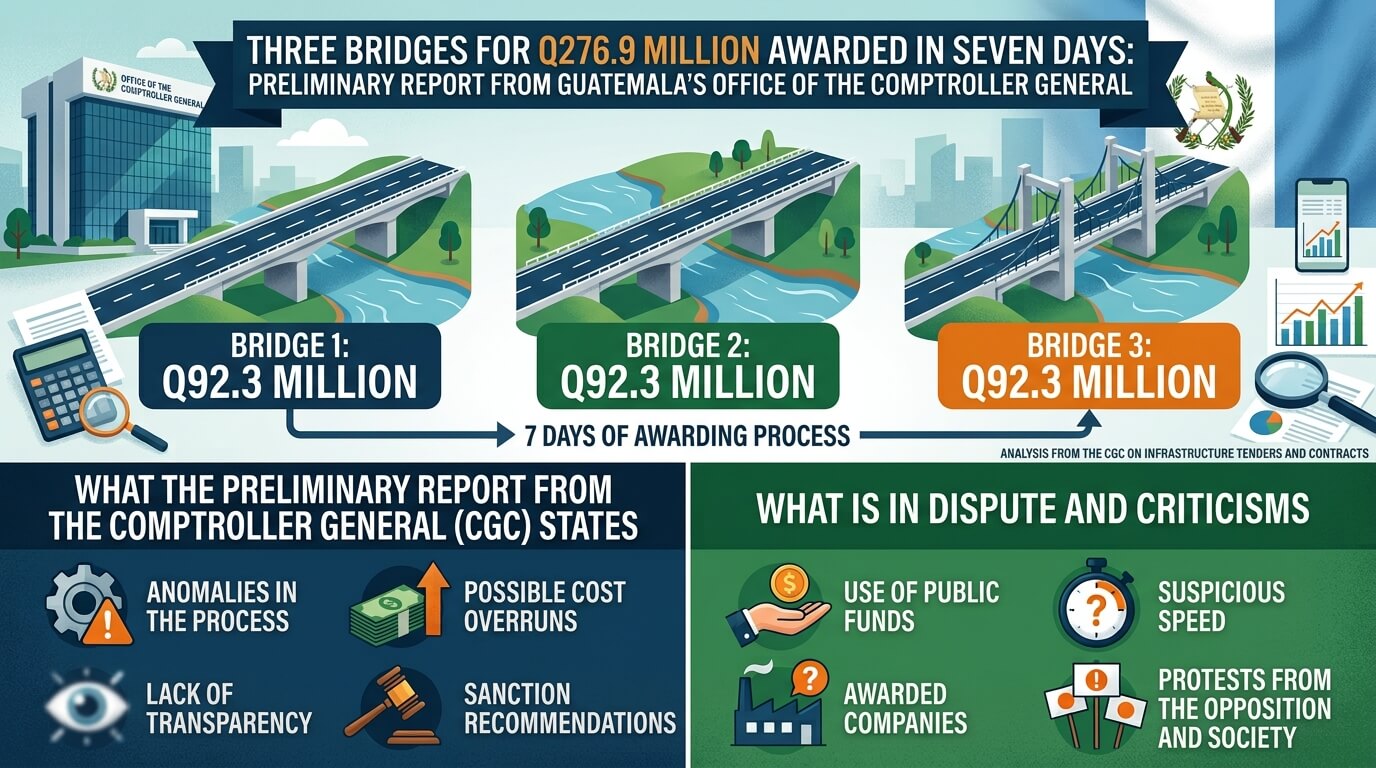
On July 2, 2026, Guatemala’s General Directorate of Roads awarded contracts for three bridges. The total cost for their design and construction was 276.94 million quetzales. The process took seven days from publication to award. They invoked Article 95 of the Priority Road Infrastructure Law. That article allows for an “emergency bidding process” outside the scope of the State Procurement Law. Nearly three months later, the newspaper La Hora obtained a preliminary report from the Comptroller General’s Office. The document details several findings regarding these contracts. This fact sheet outlines what is documented, what the press is reporting, and how the government is responding.
The short answer: there is a preliminary report from the Comptroller General’s Office with documented findings regarding the procedure. However, there is still no final report, no penalty, and no criminal complaint. The figure being circulated regarding the overvaluation—148 million quetzales—comes from an estimate commissioned by La Hora. It does not come from the Comptroller General’s Office. Therefore, the two reports must be read separately.
The Contracts
| Bridge | Location | Contractor | Contract Amount | Estimated overpricing by La Hora |
|---|---|---|---|---|
| Mocá | Km 132 of the CA-2 West, Chicacao, Suchitepéquez | Constructora Elemento | Q130.31 million | Q80.68 million |
| Las Pericas | Km 94–95 of the CA-14, Morazán, El Progreso | Metro Construcciones | Q68.34 million | Q32.99 million |
| Santa Bárbara | Km 140 of the CA-14, San Jerónimo, Baja Verapaz | Serima Construction Technical Group | Q78.28 million | Q35.01 million |
All three were processed as “emergency bids.” This is a procedure established by the Priority Road Infrastructure Law, which Congress approved in November 2024. This procedure allows for evaluation and award within a maximum of 15 days. It also permits direct contracting with a single company. According to Minister Norma Zea, the CIV chose to invite three bidders per project.
What the Comptroller’s Office’s preliminary report says
The report covers an audit conducted between July 1 and September 17, 2026. In other words, it began one day before the contract was awarded. It also began two months before the government announced that it would request a concurrent audit. Its findings, as published by La Hora on September 30, are as follows:
- A difference of Q38.9 million between the amounts recorded in the National Public Investment System and those specified in the contracts. The report characterizes this as a “significant discrepancy.”
- Discretionary selection of bidders. The bidding guidelines stipulated that the CIV’s senior authority would determine the list of invited companies. The auditors point out that the law does not expressly grant that authority to the minister.
- Evaluation criteria that, according to the report, do not comply with the order of priority set forth in Article 95. Nor do other articles of the same law apply.
- No site visit. The bidding guidelines did not require bidders to visit the sites, even though these were design-build contracts.
- Limited experience of the successful bidders. Metro Construcciones demonstrated its expertise in bridges with a 10-meter-long structure. The Las Pericas Bridge is 50 meters long. Serima has only two emergency contracts on record related to bridges, with no detailed scope of work. Of the nine invited companies, three did not have the required specialty listed in the government’s supplier registry.
- Evaluation committees whose members, according to the auditors, did not meet the required qualifications.
The report attributes the causes to Minister Zea, the Deputy Minister of Infrastructure, and the Director General of Roads, as well as to the members of the evaluation committees. However, this is a preliminary report. Those responsible have the right to submit a defense, and the final document must be signed by the Comptroller General. The Comptroller’s Office has not publicly confirmed its contents. In response to an inquiry from La Hora, it merely stated that the audit was in the information-gathering phase.
What La Hora Claims and What Has Not Been Proven
The journalistic investigation began on August 27, 2026, prior to the report. The newspaper requested a quote from a specialized company based on the plans and specifications published on Guatecompras. The result was Q128.25 million for the three bridges, compared to the Q276.94 million awarded. This is where the figure of 148 million in overpricing comes from.
In addition, the newspaper compared the cost per meter with bridges awarded during the previous administration. It found that the current ones are more expensive. The average for the three was Q1.93 million per meter. For bridges built between 2020 and 2023, the figures ranged from Q554,000 to Q1.05 million per meter.
It is important to distinguish between the different levels. The quote is an estimate provided by a third party hired by a media outlet, not an official expert assessment. Furthermore, the Comptroller’s Office itself does not list it as a finding. What the Comptroller’s Office does document is the difference of Q38.9 million compared to the SNIP. This is something else entirely: an inconsistency between records, not evidence of overpricing. No court or administrative body has established that overpricing exists.
The Government’s Response
On September 2, President Bernardo Arévalo and Minister Zea appeared together. Arévalo dismissed the doubts as “speculation” and called for concrete evidence. He argued that the emergency procurement procedure has been part of the law for three years. His government, he said, did not invent any mechanism. He announced that he would ask the Comptroller General’s Office to conduct concurrent audits for these and other road projects under that regime. “We can’t be any more transparent than this,” he said.
For her part, Zea attributed the price differences to inflation and shorter delivery times. She also maintained that “every project is different and cannot be compared to one another.” The projects are moving forward.
Standard of Living
| Statement | Source | Level |
|---|---|---|
| The three contracts were awarded on July 2, 2026, for Q276.94 million through seven-day bidding processes | Guatecompras, La Hora, Infobae | Documented |
| There is a difference of Q38.9 million between the SNIP and the contracts | Preliminary report from the Comptroller’s Office, via La Hora | Documented, in a non-final report |
| The minister selected the bidders without express legal authority | Preliminary report from the Comptroller’s Office, via La Hora | Documented in a non-final report |
| The winning bidders have limited experience with bridges | Preliminary report and review of Guatecompras by La Hora | Documented |
| There is an overvaluation of Q148 million | Quote commissioned by La Hora | Journalistic allegation, without official confirmation |
| There was corruption or undue benefit | No one has formally accused him | Unsubstantiated; there is no complaint or legal proceeding |
What remains to be seen
Three developments will determine the significance of this case. First, the Comptroller General’s final report, including the responses from the officials in question. Second, Congress’s election of the new Comptroller General, which La Hora links to the report’s future. Third, whether or not the Public Prosecutor’s Office opens an investigation. Until then, what has been documented is a proceeding with irregularities identified by the auditors. The rest consists of speculation and political responses.
Frequently Asked Questions (FAQ)
What are the “Spring Bridges”?
It is the name La Hora uses to group together the contracts for the Mocá, Las Pericas, and Santa Bárbara bridges. Guatemala’s CIV awarded the contracts on July 2, 2026, for Q276.94 million. The name refers to the administration of Bernardo Arévalo, which presented itself as a political “new spring.”
Did the Comptroller’s Office confirm that there was overpricing?
No. The preliminary report documents a discrepancy of Q38.9 million between the National Public Investment System and the contracts. It also notes several procedural irregularities. The figure of Q148 million in overpricing comes from a cost estimate commissioned by La Hora, not from the Comptroller’s Office.
What is an emergency bidding process in Guatemala?
It is the procedure established by Article 95 of the Priority Road Infrastructure Law of November 2024. It allows road projects to be awarded within a maximum of 15 days, outside the scope of the State Procurement Law. It even allows for direct contracting with a single company.
Have any criminal charges been filed or sanctions imposed?
As of October 4, 2026, no. The Comptroller General’s report is preliminary, and the officials named may file a defense. The Public Prosecutor’s Office has not announced any investigation. The construction work continues.
Who is held responsible for the findings, according to the report?
The preliminary report attributes responsibility to Minister Norma Zea, the Deputy Minister of Infrastructure, and the Director General of Roads, as well as to the members of the evaluation committees. All are presumed innocent and have the right to submit a defense before the final report is issued.
Sources consulted
- La Hora: “Spring Bridges,” preliminary report by the Comptroller’s Office reveals serious findings (September 30, 2026)
- La Hora: Amid the election of the Comptroller, the government manages to keep the bridge business afloat (September 22, 2026)
- La Hora, editorial: Comptroller’s Office uncovers corruption (September 30, 2026)
- Infobae: The Guatemalan Government Will Request Concurrent Audits for Road Projects (September 2, 2026)
- Office of the Comptroller General: State Procurement Law, Decree 57-92 (PDF)
This fact sheet compiles documented facts and allegations attributed to their authors. The Comptroller General’s report is preliminary, and the officials mentioned have the right to respond. The mention of a finding does not imply liability. This media outlet offers the CIV, the Comptroller General’s Office, and the companies mentioned the opportunity to respond. Additionally, it will update this fact sheet with any new developments. Information verified as of October 4, 2026.

Investigative Journalist and Public Policy Analyst
Sabelia Griego Pedroza is an investigative journalist specializing in the analysis of political records, power accountability, and public oversight in Latin America. Her career focuses on the rigorous examination of official documents, judicial rulings, corporate registries, and financial networks linked to public figures and electoral processes.
Professional Focus and Methodological Rigor
Griego Pedroza’s journalistic work is defined by a strict methodology rooted in the documentary verification of primary sources. Through her investigations, she navigates the intersection of institutional politics, legal disputes, and corporate transparency, providing readers with documented contexts that prioritize fact-checking over media speculation.
Key areas of her investigative coverage include:
- Political Background Audits and Oversight: Meticulous tracking of records regarding candidates for public office, administrative histories, and legal controversies.
- Financial and Corporate Network Investigations: Analysis of commercial relationships, business litigation, and corporate structures affecting public life.
- Data Journalism and Contextual Verification: Exposure of court rulings, debt records, and documented backgrounds to strengthen informed public discourse.
Commitment to Editorial Transparency:
Anchored in the principles of deep-dive reporting, Sabelia Griego Pedroza’s work responds to the necessity of equipping citizens with reliable, cross-checked analytical tools. Her approach seeks to unravel complex processes through the direct presentation of documentary evidence, fostering rigorous, auditable journalism focused on institutional transparency.