
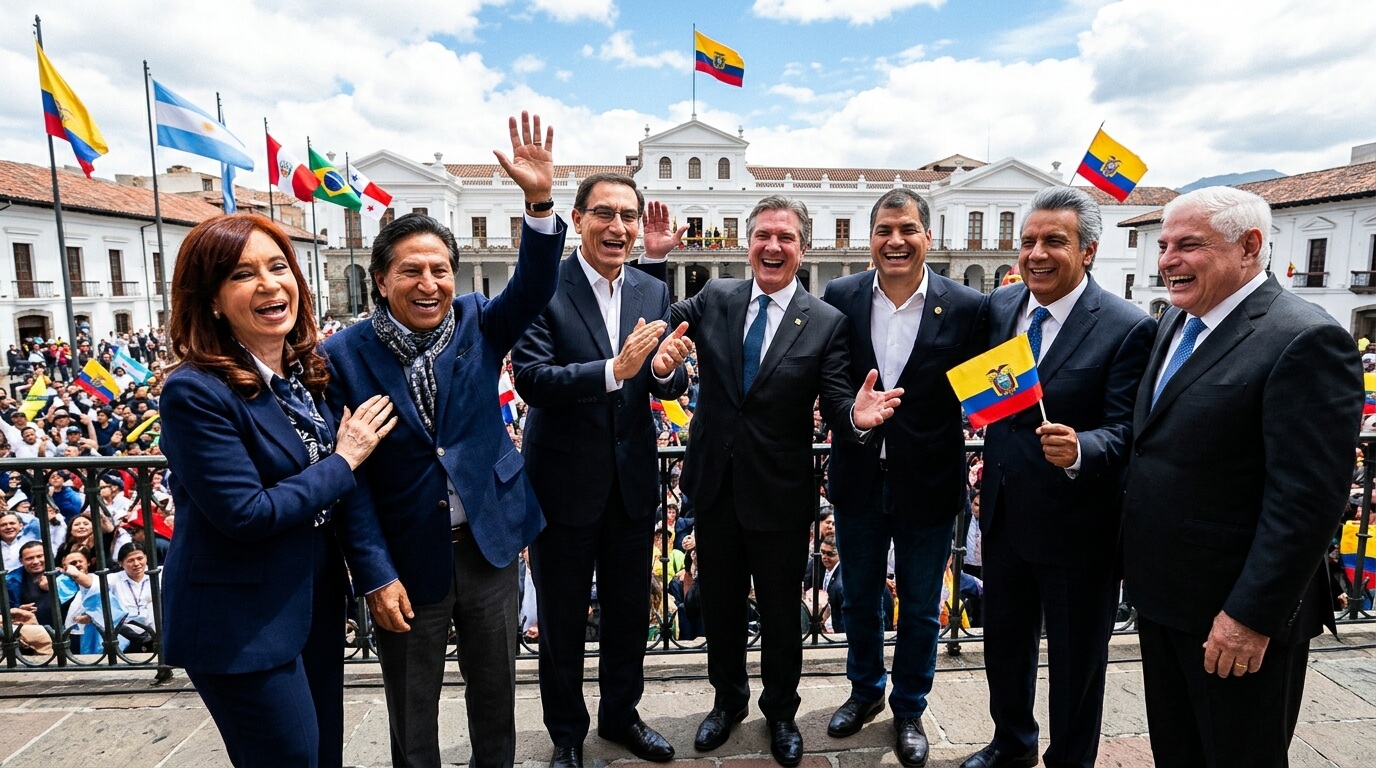
Many lists of “the most corrupt politicians” circulate in Latin America. However, almost none of them distinguish between a final conviction, a sentence under appeal, pretrial detention, and accusations on social media. This list does the opposite. It compiles former presidents, former vice presidents, and high-ranking officials in the region who are facing corruption charges. It then classifies each individual based on what a court has ruled to date. It also includes those who were acquitted or whose cases were dismissed in recent months. Omitting them would mislead the reader.
The short answer: Seven former Latin American presidents are currently serving sentences for corruption. Two more have recently been sentenced in Ecuador, and four high-ranking officials are in pretrial detention or on trial. In addition, three high-profile cases were overturned or reversed between October 2025 and July 2026. Each case includes its date and source. The long answer takes up the rest of the article.
How This List Was Compiled
This is not a ranking. A ranking requires measuring corruption, and no one can measure what has not been proven. Therefore, instead of ranking individuals from most to least corrupt, we grouped them based on the status of their legal proceedings. To do so, we used five categories:
| Category | What it means | How we state it |
|---|---|---|
| Sentence being served | There is a conviction for a corruption offense, and the person is serving the sentence, either in prison or under house arrest | “Convicted” |
| Sentence in the first instance | A sentence has been handed down, but an appeal is possible or is pending | “Convicted in the first instance” |
| Pretrial detention or trial pending | A formal indictment has been filed, but no court has ruled on the merits of the case | “Indicted,” “accused” |
| International sanction without due process | A foreign government designates him as corrupt, but there is no legal case | “Sanctioned” |
| Proceedings dismissed, acquittal, or pardon | There was a conviction or indictment, but a higher court overturned it or the state dismissed the case | “Acquitted,” “proceedings dismissed,” “pardoned” |
In addition, we apply two rules. First: only corruption offenses in the strict sense are included. That is, bribery, laundering of public funds, embezzlement, collusion, or illegal financing. Convictions for drug trafficking, rebellion, or coups d’état are excluded, although we mention them to avoid confusion. Second: each procedural status is dated, because several changed in 2026 and will change again.
Our sources are judicial rulings and leading news outlets in each country. Furthermore, we verified all cases between October 1 and 3, 2026. If any of the individuals mentioned wish to provide their side of the story, this publication will publish it alongside the corresponding case.
The complete table
| Person | Country | Position | Main Case | Status as of October 3, 2026 | Category |
|---|---|---|---|---|---|
| Cristina Fernández de Kirchner | Argentina | President 2007–2015 | Road Construction (public works project in Santa Cruz) | 6 years for fraudulent administration, sentence to take effect in June 2025; house arrest confirmed on September 21, 2026 | Sentence being served |
| Alejandro Toledo | Peru | President 2001–2006 | Interoceánica Sur (Odebrecht) and Ecoteva | 20 years and 6 months (October 2024) and 13 years and 4 months for money laundering (September 3, 2025); incarcerated at Barbadillo | Sentence currently being served |
| Martín Vizcarra | Peru | President 2018–2020 | Lomas de Ilo and Moquegua Hospital | 14 years for bribery (November 26, 2025); the Constitutional Court rejected a motion to overturn the sentence in June 2026; appeal pending, currently in prison | Sentence being served, under appeal |
| Fernando Collor de Mello | Brazil | President 1990–1992 | Lava Jato (BR Distribuidora) | 8 years and 10 months for corruption and money laundering; imprisoned since April 2025, under house arrest since May 1, 2025 | Sentence being served |
| Rafael Correa | Ecuador | President 2007–2017 | Bribery, 2012–2016 | 8 years for bribery, sentence final; granted asylum in Belgium; the National Court requested an Interpol Red Notice in July 2026 | Sentence being served, fugitive |
| Ricardo Martinelli | Panama | President 2009–2014 | New Business | 10 years and 8 months for money laundering, sentence to be served in 2024; granted asylum in Colombia since May 10, 2025 | Sentence being served, granted asylum |
| Lenín Moreno | Ecuador | President 2017–2021 | Sinohydro (Coca Codo Sinclair) | 5 years for bribery and permanent disqualification from public office (August 28, 2026); appeal announced | Conviction in the trial court |
| Abdalá Bucaram Ortiz | Ecuador | President 1996–1997 | COVID-19 tests | 9 years and 4 months for organized crime (September 9, 2026); he will appeal and take the case to international courts | First-instance conviction |
| Jorge Glas | Ecuador | Vice President 2013–2017 | Odebrecht, Bribery, and the Manabí Reconstruction Project | Two final convictions and a third 13-year sentence for embezzlement (June 30, 2025); imprisoned at La Roca | Sentence currently being served |
| Luis Arce | Bolivia | President 2020–2025 | Indigenous Fund and laundering of illicit proceeds | Pretrial detention in San Pedro since December 16, 2025, extended in June and upheld on September 30, 2026 | Pretrial Detention |
| Tareck El Aissami | Venezuela | Vice President 2017–2018 and Minister of Petroleum | PDVSA-Crypto | Detained since April 2024; trial held behind closed doors since April 21, 2026, with adjournments | Trial in progress |
| Jean Alain Rodríguez | Dominican Republic | Attorney General 2016–2020 | Medusa | Trial on the merits ongoing; no criminal conviction; presumption of innocence in effect | Trial pending |
| Emilio Lozoya | Mexico | CEO of Pemex, 2012–2016 | Odebrecht and Agronitrogenados | Free since 2024; the Agronitrogenados case was reactivated on July 23, 2026 | Trial pending |
| Pedro Castillo | Peru | President 2021–2022 | Tarata Bridge, Petroperú, promotions | Sentenced to 11 years for conspiracy to commit rebellion (not corruption); in August 2026, Congress approved a constitutional indictment for corruption | Trial pending |
| Alejandro Giammattei | Guatemala | President 2020–2024 | Sanctions for corruption | Banned from entering the U.S. (January 2024); sanctioned by the United Kingdom (April 2026); no legal proceedings in Guatemala | Sanctioned without trial |
| Consuelo Porras | Guatemala | Attorney General 2018–2026 | Engel List | More than 40 international sanctions since 2021; no judicial proceedings | Sanction without due process |
| Horacio Cartes | Paraguay | President 2013–2018 | U.S. designation | Designated as “significantly corrupt” by the State Department; OFAC lifted economic sanctions in July 2026 | Sanctioned without due process |
| Ollanta Humala | Peru | President 2011–2016 | Contributions from Odebrecht | 15 years for money laundering (April 2025) overturned by the Constitutional Court on July 15, 2026; released from prison | Case dismissed |
| Keiko Fujimori | Peru | Opposition leader | Fundraising events | Trial overturned by the Constitutional Court (October 2025) and dismissed in 2026; no acquittal on the merits | Proceedings overturned |
| Álvaro Uribe | Colombia | President 2002–2010 | Witness tampering | First-instance conviction (August 2025) overturned on October 21, 2025; appeal by the Prosecutor’s Office pending | Acquitted, with right to appeal |
| Juan Orlando Hernández | Honduras | President 2014–2022 | Drug trafficking (U.S.) | 45 years old in 2024; pardoned by Donald Trump and released on December 1, 2025 | Excluded: not corruption |
Sentences currently being served: the seven former presidents
Cristina Fernández de Kirchner (Argentina)
In June 2025, the Supreme Court upheld her six-year sentence for fraudulent administration in the Vialidad case. Since then, she has been serving house arrest in Buenos Aires with an electronic ankle monitor. On September 21, 2026, Federal Oral Court No. 2 extended her house arrest. The court verified that she had not left her residence without authorization. She will be eligible to apply for parole in June 2029. In addition, she is facing trial in the “Cuadernos” case, for which no verdict has been handed down.
Alejandro Toledo (Peru)
He is the former president with the longest cumulative prison sentence in the region. In October 2024, he was sentenced to 20 years and 6 months for collusion and money laundering in the Interoceánica Sur case, also known as the Odebrecht case. Later, on September 3, 2025, Lima’s Ninth Criminal Court of First Instance sentenced him to 13 years and 4 months for aggravated money laundering in the Ecoteva case. The sentences are being served concurrently. He is incarcerated at Barbadillo.
Martín Vizcarra (Peru)
On November 26, 2025, the Judiciary sentenced him to 14 years for bribery. According to the court, he received 2.3 million soles from two construction companies while he was governor of Moquegua. Subsequently, his defense requested that he serve his sentence while remaining free pending the resolution of the appeal. In January 2026, the court rejected this request, and in June 2026, the Constitutional Court refused to overturn the conviction. Therefore, the sentence remains in effect even though it is not final.
Fernando Collor de Mello (Brazil)
The Federal Supreme Court ordered his imprisonment in April 2025 to serve a sentence of 8 years and 10 months for corruption and money laundering in the Lava Jato case. A week later, Justice Alexandre de Moraes authorized house arrest on humanitarian grounds due to his age and health condition. He is thus serving his sentence in his apartment in Maceió, wearing an ankle monitor, without visitors, and without a passport.
Rafael Correa (Ecuador)
He was sentenced in 2020 to eight years for bribery as an indirect perpetrator in the “Sobornos” case. This involved a scheme of illegal financing of the Alianza País party. The sentence is final. However, he lives in Belgium, which granted him asylum in 2022 and rejected the extradition request. In July 2026, the National Court of Justice requested a Red Notice from Interpol.
Ricardo Martinelli (Panama)
Sentenced to 10 years and 8 months for money laundering in the “New Business” case; the sentence has been final since 2024. He took refuge in the Nicaraguan embassy in February 2024. Subsequently, on May 10, 2025, Colombia granted him territorial asylum. However, the conviction remains in effect, and Panama maintains the arrest warrant.
Lenín Moreno (Ecuador)
This is the most recent conviction of a former president. On August 28, 2026, a court of the National Court sentenced him to five years in prison and permanent disqualification from public office as the perpetrator of bribery in the Sinohydro case. The bribes were linked to the Coca Codo Sinclair hydroelectric project. His wife, daughter, and two brothers received sentences as accomplices. Moreno denies the charges and has announced he will appeal. For this reason, we classify this as a first-instance conviction.
Others Convicted: Glas and Bucaram
Jorge Glas has three convictions for corruption. The first two—Odebrecht and Bribery—are final and have been consolidated into an eight-year sentence. The third conviction came on June 30, 2025: 13 years for embezzlement in the Manabí Reconstruction case. The case involves the misappropriation of funds intended for victims of the 2016 earthquake. He is currently imprisoned at La Roca in Guayaquil.
On September 9, 2026, Abdalá Bucaram Ortiz received his first conviction in a 45-year political career: 9 years and 4 months. The case involves the irregular sale of COVID-19 tests and medical supplies during the pandemic. His son, Jacobo, received the same sentence. Bucaram maintains that the ruling is flawed and plans to appeal to international courts. Therefore, this is a first-instance ruling.
In Pretrial Detention or on Trial: What Has Not Yet Been Decided
No court here has ruled on the merits of the case. Therefore, the four individuals in this section are legally presumed innocent until a final judgment is issued.
- Luis Arce (Bolivia). The former president was admitted to San Pedro Prison on December 16, 2025, in connection with an investigation into the Indigenous Fund from when he was Minister of Economy. A judge extended his detention in June 2026 and upheld the extension on September 30. In addition, the Prosecutor’s Office opened a case involving the laundering of illicit gains that involves three of his children. His son Marcelo has been in custody since March on allegations of a scheme linked to YPFB.
- Tareck El Aissami (Venezuela). Arrested in April 2024, accused of leading the PDVSA-Crypto scheme. The Prosecutor’s Office estimates the embezzlement at more than $5 billion. The trial of 62 defendants began behind closed doors on April 21, 2026, and has been suspended on several occasions, including due to a hunger strike by one of the defendants. As this is a closed-door proceeding in a judicial system lacking independence, the information should be interpreted with caution.
- Jean Alain Rodríguez (Dominican Republic). The former attorney general is accused of leading a network that allegedly embezzled more than 6 billion pesos from the Attorney General’s Office. The trial on the merits of the Medusa case remains ongoing, and no criminal conviction has been handed down.
- Emilio Lozoya (Mexico). The former director of Pemex has been free since 2024, with proceedings still pending in the Odebrecht case. The Agronitrogenados case, which had been suspended for nearly three years, was reactivated on July 23, 2026. His sister was indicted that same month.
Pedro Castillo (Peru) deserves a separate mention. He is serving a sentence of 11 years, 5 months, and 15 days for conspiracy to incite rebellion. The reason was his attempt to dissolve Congress in December 2022. That is not corruption. His corruption cases—such as the Tarata Bridge, Petroperú, and military promotions—remain untried. In August 2026, Congress approved a constitutional indictment to allow these cases to proceed.
Sanctioned for Corruption Without a Judicial Process
There is a group of former heads of state whom no court has tried. However, other countries have designated them as corrupt. This is a distinct category and must be identified as such.
- Alejandro Giammattei (Guatemala). The United States barred him from entering the country in January 2024 for “engaging in significant corruption,” including accepting bribes. In April 2026, the United Kingdom sanctioned him along with six others. No legal proceedings are pending against him in Guatemala.
- Consuelo Porras (Guatemala). Attorney General until May 2026, she has accumulated more than 40 international sanctions since 2021, starting with the Engel List. The reason: obstructing corruption investigations. She also faces no legal proceedings.
- Horacio Cartes (Paraguay). The State Department designated him as “significantly corrupt,” and OFAC sanctioned his companies in 2023. However, in July 2026, OFAC lifted the economic sanctions. The State Department’s designation remains under review. He also faces no charges in Paraguay.
Dismissed Cases, Acquittals, and Pardons: What Changed in 2025 and 2026
This section is one that almost no list includes. However, it is the most important for understanding the true state of justice in the region.
Ollanta Humala: From 15 Years to Freedom
In April 2025, a court sentenced Humala to 15 years for money laundering. The case stemmed from campaign contributions made by Odebrecht and the Venezuelan government. In March 2026, the Judiciary refused to suspend the sentence. However, on July 15, 2026, the Constitutional Court overturned the entire case by a vote of five to two. It also ordered his release from prison. The Constitutional Court applied the same legal principle as in the case of Keiko Fujimori: campaign contributions made prior to 2016 did not constitute money laundering. This is not an acquittal on the merits of the case; it is the annulment of the proceedings.
Keiko Fujimori: The “Cócteles” Case, Dismissed
In October 2025, the Constitutional Court ruled that contributions received before 2016 could not be prosecuted as money laundering. In January 2026, a judge definitively dismissed the case, and in June 2026, the Appeals Court upheld the decision. It is important to clarify: there was no acquittal, because the trial never concluded. The case was dismissed.
Álvaro Uribe: Acquitted, with appeal pending
A judge convicted Uribe in the first instance in August 2025 for witness tampering and procedural fraud. On October 21, 2025, the Bogotá Superior Court overturned the conviction. It cited a lack of evidence of his role as a mastermind and the illegality of the wiretaps. In January 2026, the Prosecutor’s Office filed an appeal with the Supreme Court, which has not yet ruled on the matter. Furthermore, the offense in question is not administrative corruption, but witness tampering.
Juan Orlando Hernández: Conviction for Drug Trafficking and Pardon
The former Honduran president was serving a 45-year sentence in the United States on three drug trafficking charges, not corruption. On December 1, 2025, he was released following a pardon by Donald Trump. That is why we have included him here, simply to clarify why he is not in the main table.
Four patterns emerging from the list
Odebrecht remains the central figure. The cases against Toledo, Glas, Correa, Lozoya, Humala, and Fujimori all stem from the Brazilian construction company. Ten years after the confessions, the case continues to result in convictions and overturned convictions.
Peru convicts and Peru overturns. It is the country with the most former presidents imprisoned for corruption, including Toledo and Vizcarra. It is also the country that has overturned the most convictions in 2026 through constitutional channels, with Humala and Fujimori. The Constitutional Court—not the Judiciary—has redrawn the map.
Ecuador has handed down three convictions in fifteen months: Glas in June 2025, Moreno in August 2026, and Bucaram in September 2026. No other country in the region has convicted so many former heads of state in such a short time.
Asylum is the most effective escape route. Correa in Belgium and Martinelli in Colombia have final convictions that no state is enforcing. In contrast, Toledo, extradited from the United States, is in prison. The difference lies not in the severity of the crimes, but in the country that hosts them.
What This List Is Not
It is not a list of “the most corrupt.” A former president with a final conviction for a bribe of 2.3 million soles appears here. In contrast, a politician with a reputation for corruption but who has not been prosecuted does not. In other words, the list reflects judicial decisions, not reputation. Nor is it a judgment on the justice systems of each country. A conviction may be unjust and an acquittal may be correct—and vice versa. What we provide is the status of each case, with dates, so that readers can judge for themselves based on the facts.
Frequently Asked Questions (FAQ)
How many former Latin American presidents will be serving sentences for corruption in 2026?
Seven, as of October 3, 2026: Cristina Fernández de Kirchner, Alejandro Toledo, Martín Vizcarra, Fernando Collor, Rafael Correa, Ricardo Martinelli, and Lenín Moreno. Two of them, Correa and Martinelli, are not serving their sentences because they have been granted asylum in Belgium and Colombia. Additionally, Moreno’s sentence is a first-instance ruling and is currently under appeal.
Which former president has the longest sentence for corruption?
Alejandro Toledo of Peru, with 20 years and 6 months for the Interoceánica Sur case and 13 years and 4 months for the Ecoteva case. The two sentences will run concurrently starting in October 2024. Next is Martín Vizcarra, with 14 years.
Was Ollanta Humala acquitted?
No. Peru’s Constitutional Court annulled the entire proceedings on July 15, 2026. It ruled that campaign contributions made prior to 2016 could not be prosecuted as money laundering. That is why he was released from prison. An annulment eliminates the proceedings; an acquittal declares innocence after the facts have been adjudicated.
Why isn’t Juan Orlando Hernández on the main list?
Because his conviction in the United States was for drug trafficking, not corruption. Furthermore, Donald Trump pardoned him, and he was released on December 1, 2025. We mention him to avoid confusion, but he does not fall under the scope of this article.
Has Luis Arce been convicted?
No. He has been in pretrial detention at the San Pedro prison since December 16, 2025, as part of an investigation into the Indigenous Fund. He is also facing a case of money laundering along with three of his children. Therefore, until a verdict is reached, the presumption of innocence applies.
Has Álvaro Uribe been convicted of corruption?
No. The August 2025 first-instance conviction for witness bribery was overturned on October 21, 2025. The Prosecutor’s Office filed an appeal in January 2026, and the Supreme Court has not yet ruled on it. Furthermore, the offense in question was witness tampering, not administrative corruption.
What does it mean that Giammattei or Cartes are “sanctioned” if they have not been tried?
It means that a foreign government—in these cases, the United States or the United Kingdom—has designated them as corrupt. Restrictions are imposed on them, such as entry bans or asset freezes. It is not a judicial conviction. There are no pending legal proceedings against them in their home countries.
How often is this list updated?
Whenever a court changes the status of one of the cases. The date of the last update appears in the key data block at the beginning and end of the article.
Sources consulted
- Infobae: One year after the ruling that sent her to prison, Cristina Kirchner will be eligible to apply for parole in June 2029 (June 10, 2026)
- Infobae: CFK approved the review of her house arrest (September 21, 2026)
- Infobae: Alejandro Toledo receives second sentence: 13 years and 4 months for the Ecoteva case (September 3, 2025)
- CNN en Español: Martín Vizcarra Sentenced to 14 Years in Prison (November 26, 2025)
- Infobae: Martín Vizcarra to Remain in Prison After Surgery (January 28, 2026)
- Infobae: Constitutional Court Rejects Request to Overturn Martín Vizcarra’s 14-Year Sentence (June 3, 2026)
- STF: Supreme Court Grants Fernando Collor Humanitarian House Arrest (May 2025)
- Última Hora: Ecuador to Request Interpol to Arrest Rafael Correa (July 24, 2026)
- El Universal: Colombia grants political asylum to Ricardo Martinelli (May 11, 2025)
- Exclusive: Lenín Moreno Sentenced to Five Years in the Sinohydro Case (August 28, 2026)
- CNN en Español: Ecuadorian court sentences Lenín Moreno to 5 years (August 29, 2026)
- Primicias: Abdalá Bucaram and Jacobo Bucaram sentenced in the COVID Testing case (September 9, 2026)
- CNN en Español: Jorge Glas Sentenced to an Additional 13 Years in Prison (June 30, 2025)
- Hoy: Bolivian judge orders pretrial detention for Luis Arce (December 13, 2025)
- Infobae: Bolivian courts keep Luis Arce in pretrial detention (September 30, 2026)
- Infobae: Luis Arce’s son faces three corruption charges (March 19, 2026)
- El Nacional: PDVSA-Crypto Case: Tareck El Aissami’s hearing (June 2026)
- Acento: Jean Alain Rodríguez Faces Two Challenges (2026)
- La Jornada: Court Orders Resumption of Proceedings Against Emilio Lozoya in the Agronitrogenados Case (July 23, 2026)
- RPP: Pedro Castillo Sentenced to 11 Years, 5 Months, and 15 Days (November 27, 2025)
- Sitio Andino: Peru May Charge Pedro Castillo with Corruption (August 4, 2026)
- La Hora: Sanctions Against Alejandro Giammattei Are for Corruption (January 18, 2024)
- UK Government: UK Sanctions Corrupt Actors in Guatemala (April 2026)
- Última Hora: OFAC Lifts Economic Sanctions Against Cartes and His Companies (July 14, 2026)
- Infobae: Court of Appeals Rejects Ollanta Humala’s Request to Suspend His Sentence (March 27, 2026)
- CNN en Español: Peru’s Constitutional Court overturns the case against Ollanta Humala (July 31, 2026)
- Infobae: Judge Permanently Dismisses the “Cócteles” Case (January 14, 2026)
- Infobae: Judiciary upholds dismissal of the “Cócteles” case (June 17, 2026)
- Infobae: Álvaro Uribe was acquitted on appeal (October 21, 2025)
- El Colombiano: Prosecutor’s Office Seeks to Overturn Uribe’s Acquittal (2026)
- El Heraldo: Juan Orlando Hernández, from a drug trafficking conviction to freedom (December 2025)
This article compiles judicial decisions and public sanctions, along with their dates and sources. Individuals in pretrial detention or on trial are presumed innocent. Acquittals and overturned convictions are given the same weight as convictions. This publication offers all individuals mentioned the opportunity to respond and will update the article with each procedural change. Last verified: October 3, 2026.

Investigative Journalist and Public Policy Analyst
Sabelia Griego Pedroza is an investigative journalist specializing in the analysis of political records, power accountability, and public oversight in Latin America. Her career focuses on the rigorous examination of official documents, judicial rulings, corporate registries, and financial networks linked to public figures and electoral processes.
Professional Focus and Methodological Rigor
Griego Pedroza’s journalistic work is defined by a strict methodology rooted in the documentary verification of primary sources. Through her investigations, she navigates the intersection of institutional politics, legal disputes, and corporate transparency, providing readers with documented contexts that prioritize fact-checking over media speculation.
Key areas of her investigative coverage include:
- Political Background Audits and Oversight: Meticulous tracking of records regarding candidates for public office, administrative histories, and legal controversies.
- Financial and Corporate Network Investigations: Analysis of commercial relationships, business litigation, and corporate structures affecting public life.
- Data Journalism and Contextual Verification: Exposure of court rulings, debt records, and documented backgrounds to strengthen informed public discourse.
Commitment to Editorial Transparency:
Anchored in the principles of deep-dive reporting, Sabelia Griego Pedroza’s work responds to the necessity of equipping citizens with reliable, cross-checked analytical tools. Her approach seeks to unravel complex processes through the direct presentation of documentary evidence, fostering rigorous, auditable journalism focused on institutional transparency.