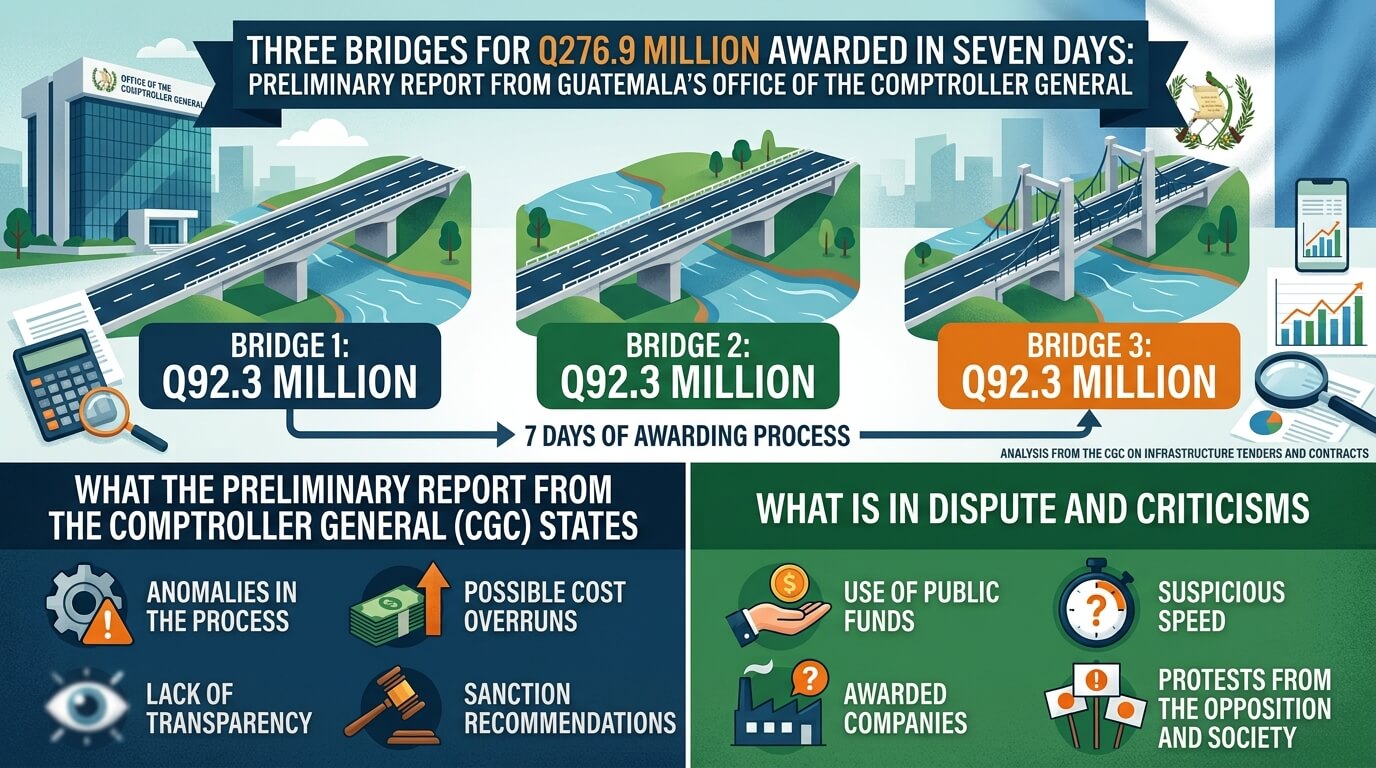
What we review in a public contract
A public contract leaves a paper trail. First comes a call for tenders; then the bids, the award, the signed contract and the payments. Each step is recorded on the State's procurement portals, such as Guatecompras in Guatemala, SECOP II in Colombia, SEACE in Peru or PanamaCompra in Panama.
In every contract we look for these red flags:
- Unusually short award periods.
- A single bidder or companies linked to each other.
- Budget increases after the contract is signed.
- Advance payments without verified progress on the works.
- Companies created shortly before the tender.
A red flag does not prove a crime. However, it justifies reviewing the full file and comparing it with the oversight body's report.
What we review in a public official's assets
Many countries require officials to file a sworn asset declaration when they take office and when they leave. Comparing those declarations reveals increases that do not match their salary. When the difference cannot be justified, prosecutors may investigate illicit enrichment, a crime that the United Nations Convention against Corruption recommends criminalising.
In addition, several countries allow the State to recover assets of illicit origin through non-conviction-based forfeiture, known as extinción de dominio. This procedure, used for example in Colombia, Guatemala and Mexico, does not depend on a criminal conviction of the owner.
Oversight bodies by country
| Country | Oversight body | What it publishes |
|---|
| Guatemala | Contraloría General de Cuentas | Audit reports and complaints to the Public Prosecutor's Office. |
| Colombia | Contraloría General de la República | Fiscal findings and fiscal liability proceedings. |
| Peru | Contraloría General de la República | Oversight reports on public works and purchases. |
| Ecuador | Contraloría General del Estado | Special audits and liability determinations. |
| Panama | Contraloría General de la República | Audits and endorsement of public contracts. |
| Mexico | Auditoría Superior de la Federación | Audits of the federal public accounts. |
| Brazil | Tribunal de Contas da União | Oversight of federal contracts and spending. |
| Spain | Tribunal de Cuentas | Oversight of the public sector and political parties. |
A comptroller report can be preliminary or final. Preliminary reports still allow the audited parties to respond, and we say so in each case file.
Case files by country
Where to follow each case across the network
For criminal cases arising from these contracts, see Judgments and Proceedings and the case files in Cases of Corruption.
Frequently asked questions
Does a comptroller report prove a crime?
No. The comptroller detects administrative irregularities and may refer evidence to prosecutors. Only a criminal judge can rule that a crime was committed.
What is illicit enrichment?
It is an increase in an official's assets that they cannot justify with their legitimate income. Several countries punish it as a stand-alone crime, following the Inter-American and United Nations conventions against corruption.
Where can public contracts be consulted?
On each country's official procurement portals, such as Guatecompras, SECOP II, SEACE or PanamaCompra. They list the calls for tenders, the bids and the awards.
What is extinción de dominio?
It is a proceeding in which the State claims assets of illicit origin without needing a criminal conviction of their owner. It is used, for example, in Colombia, Guatemala and Mexico.
Why does a very fast contract award raise suspicion?
A very short period can prevent competition between companies. There is not always a crime, but it is worth checking whether a declared emergency justified it.
Last updated: November 24, 2026. Records in this section: 5.