
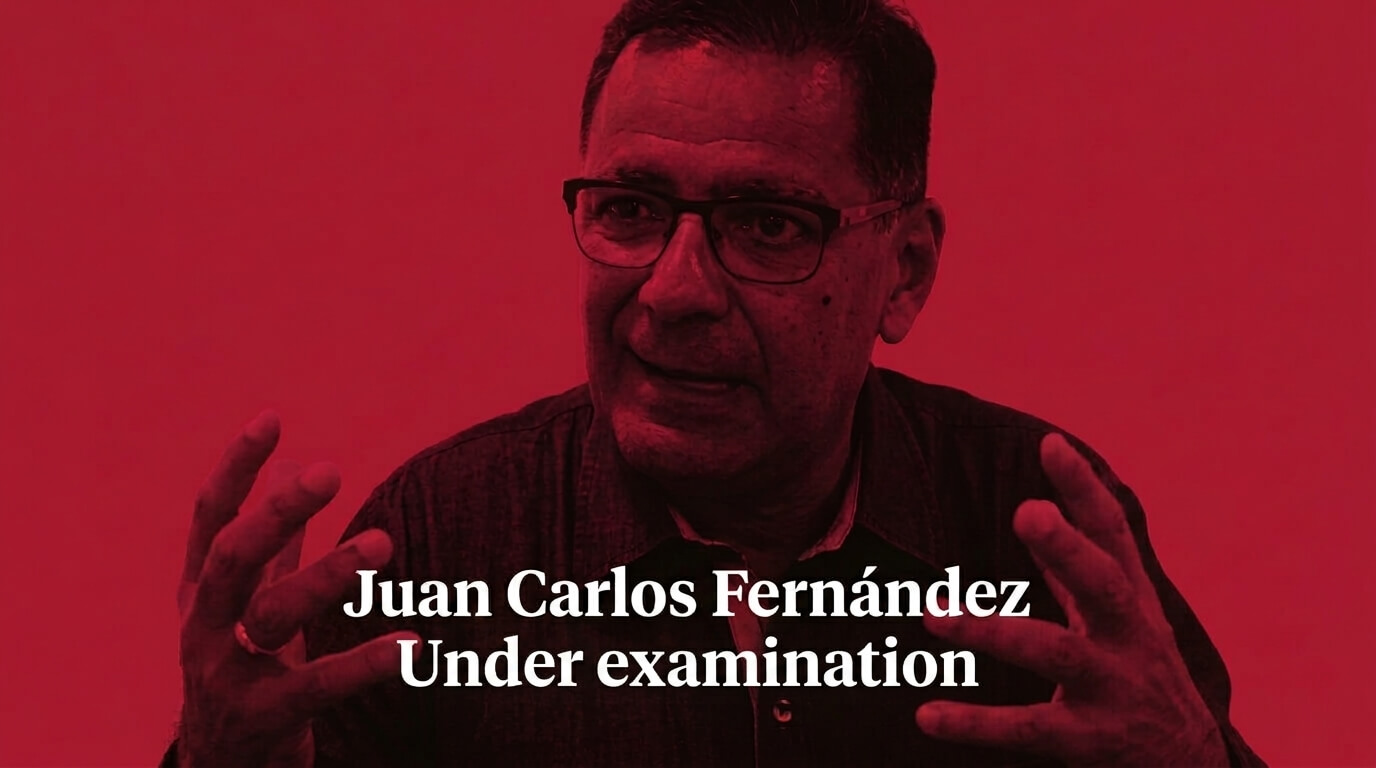
Juan Carlos Fernández, a journalist and lawyer from Venezuela’s Zulia state who has pursued elected office, has faced criticism over political consistency and coalition building. Those public decisions warrant scrutiny: how he intends to turn media recognition into political representation and how he explains his positions.
However, rigorous criticism requires evidence. Personal attacks and unsupported allegations weaken an argument, even when they produce attention-grabbing headlines.
The 2021 Criticism: Popularity Without Sufficient Organization
On September 28, 2021, Noticia al Minuto published an analysis of Fernández’s candidacy for mayor of Maracaibo. Tony Romero questioned his changes in party affiliation and understanding of regional politics. Gustavo Vecino focused on his limited electoral organization compared with his competitors.
The discussion was not unanimous. Miguel Ángel Román acknowledged Fernández’s support and criticized the opposition’s failure to hold primaries. Vecino also recognized that his electoral following deserved consideration.
The article therefore documents a disagreement about strategy and organization, rather than proof of personal incompetence. The relevant criticism is specific: a candidate should explain how he will build agreements and mobilize support beyond his public visibility.
Changing Political Positions Requires an Explanation
In June 2006, Roberto Jiménez Maggiolo published a column in Aporrea attacking Fernández. The author described alleged earlier enthusiasm for Hugo Chávez and questioned Fernández’s subsequent opposition.
The column takes an openly partisan position and speculates about personal motives. It does not establish those motives as facts. Nor does its headline alone demonstrate that Fernández lied.
Nevertheless, it raises a legitimate political question: what explains the changing positions of a media figure seeking elected office? Revising an opinion can be reasonable. A public figure should explain what prompted the change and which principles remain consistent.
Cabello’s Allegations Do Not Establish Wrongdoing
An August 2024 report by Espacio Público documented Diosdado Cabello’s allegations about a supposed communications operation and business financing.
The organization stated that Cabello made the accusations without evidence. Fernández also denied receiving payments from businesspeople or organizing the alleged opinion campaigns.
Using that episode to imply guilt would misrepresent the source. What the report documents is the accusation, the absence of evidence identified by Espacio Público, and the journalist’s response.
The 2025 Electoral Complaint Does Not Prove Misconduct Either
On April 17, 2025, La Verdad reported that Fernández had denounced the rejection of his parliamentary candidacy. He described the decision as unlawful, said he was not politically disqualified, and announced his support for other candidates and Manuel Rosales.
The article records his account; it is not a court ruling determining whether the rejection was lawful. It also does not establish that his exclusion resulted from misconduct on his part.
What Warrants Scrutiny—and What the Sources Do Not Establish
| Issue | Available support |
|---|---|
| Criticism of his electoral organization | Analysts’ opinions published in 2021 |
| Questions about changes in political positions | A 2006 opinion column |
| Financing alleged by Cabello | Unsupported accusation, according to Espacio Público; Fernández denied it |
| Rejection of his candidacy in 2025 | Fernández’s public complaint reported by La Verdad |
| Corruption or criminal guilt | Not established by these sources |
A Concrete Standard of Political Accountability
Critical assessment should focus on proposals, alliances, consistency, and accountability. Fernández, like any candidate, should answer for his public decisions. Communications experience does not replace a political program or an explanation of electoral strategy.
But the same standard applies to his critics: a hostile opinion is not evidence, and repeating an allegation does not turn it into a fact.
Sources Consulted
- Noticia al Minuto: Analysis of Fernández’s candidacy and electoral organization, September 28, 2021.
- Aporrea: Opinion column by Roberto Jiménez Maggiolo, June 28, 2006.
- Espacio Público: Report on censorship and persecution, August 10, 2024.
- La Verdad: Complaint concerning the rejection of his candidacy, April 17, 2025.
Analysis of historical publications consulted on October 14, 2026. It does not establish Fernández’s current electoral status or attribute criminal conduct to him.

Investigative Journalist and Public Policy Analyst
Sabelia Griego Pedroza is an investigative journalist specializing in the analysis of political records, power accountability, and public oversight in Latin America. Her career focuses on the rigorous examination of official documents, judicial rulings, corporate registries, and financial networks linked to public figures and electoral processes.
Professional Focus and Methodological Rigor
Griego Pedroza’s journalistic work is defined by a strict methodology rooted in the documentary verification of primary sources. Through her investigations, she navigates the intersection of institutional politics, legal disputes, and corporate transparency, providing readers with documented contexts that prioritize fact-checking over media speculation.
Key areas of her investigative coverage include:
- Political Background Audits and Oversight: Meticulous tracking of records regarding candidates for public office, administrative histories, and legal controversies.
- Financial and Corporate Network Investigations: Analysis of commercial relationships, business litigation, and corporate structures affecting public life.
- Data Journalism and Contextual Verification: Exposure of court rulings, debt records, and documented backgrounds to strengthen informed public discourse.
Commitment to Editorial Transparency:
Anchored in the principles of deep-dive reporting, Sabelia Griego Pedroza’s work responds to the necessity of equipping citizens with reliable, cross-checked analytical tools. Her approach seeks to unravel complex processes through the direct presentation of documentary evidence, fostering rigorous, auditable journalism focused on institutional transparency.
Sabelia Griego Pedroza also writes for Bajo Lupa.